How can you heal your brain after years of frying your dopamine circuits with porn use and other addictive behaviors?
It can feel hopeless at times and often the answer to this question is long and complicated. But all the long and complicated answer overlook one crucial factor: healing happens automatically, all by itself and there's nothing you have to do.
You don't have to make an extra effort to get there, you just have to stop swimming upstream.
I know that sounds too good to be true. The assumption baked into our culture is that recovery means adding things: more discipline, more techniques, more experts, more systems, more effort stacked on top of effort. When something's wrong, you go find the person who fixes it, buy the thing that fixes it, learn the method that fixes it. More, more, more.
What if the answer is less?
TL;DR: Your body and mind already have a natural tendency toward health, like a gravity well constantly pulling you toward well-being. Healing isn't about adding effort. It's about removing interference. The most powerful and accessible intervention available to you is doing nothing: stopping the constant input and stimulation that keeps you swimming upstream.
Proof that Healing is the Default Setting
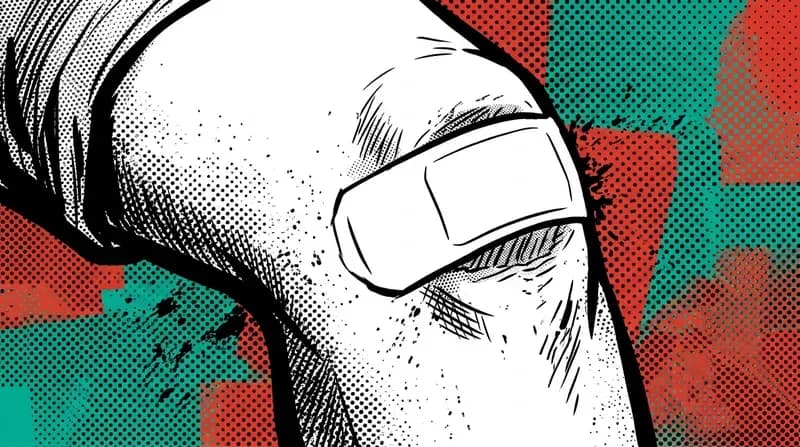
Healing happens by itself. That's the basic idea and the simplest proof of this is something you've no doubt experienced many times: small injuries.
You cut your finger, scrape your knee, twist your ankle...
What happens next? It heals.
And what exactly do you have to do for this healing to happen? Basically, nothing. No special knowledge required. No expert needed to instruct your body on what to do. No complicated system.
In practice, you clean the wound, you bandage it. If you've sprained a join, you maybe put it in a brace. And then you wait.
What all of these things have in common is that you ensure that there's no further aggravation. If you've cut yourself, you have to make sure there's no dirt entering the wound. But that's it. You make sure nothing gets in the way and the rest is your body's natural healing process.
Now what if this doesn't just apply to injuries to your body? What if this is a general rule: your body tends towards healing. Always.
The only intervention required is identifying what's obstructing that natural process and getting it out of the way.
Which means the answer is not "do more things to solve this problem" but "stop interfering and let the problem solve itself."
The Incredibly Healing Power of NOT Eating
There's a clinic called the True North Health Center that puts people with serious, long-lasting chronic conditions on water fasts. We're talking about people who've already failed medication, failed multiple interventions, and arrived at the end of what conventional medicine could offer them.
The protocol: eat nothing, drink only water, and rest. That's it.
Patients do this, under strict medical supervision, for anything from 5 days for up to 40 days. Medically supervised water-only fasting has been studied clinically for conditions like hypertension, insulin resistance, arthritis and other inflammatory conditions - with measurable improvements in patients who had exhausted conventional options.
Outcomes are good, sometimes spectacularly good.
Think about that for a moment: the entire treatment is to stop eating. My read on this is that you take someone with some intractable chronic health condition and you stop all interference. Most people's diets are somewhere between bad and catastrophic. The average person eats too much sugar, too much processed and ultra-processed foods and food-like products, too many trans fats and other things that were never meant to enter a human body.
It's hard to track down what exactly causes which health conditions. But if you just remove all of it, just stop eating all together, the body starts healing.
Now just to be clear: I am not telling you to go on a forty-day water fast. That kind of thing really needs medical supervision.
But you can try out the benefits of fasting at a smaller scale. Some people report noticeable benefits from just a daily 16-hour fast. That's basically skipping one meal. Or you can try a 24 or 36 hour fast. Those can be done safely by anyone who's in reasonably good health. I personally do this several times a year and every time, I feel great (and think to myself: "I should do this more often").
Fasting isn't a new biohacker trick, either. It's been a spiritual and therapeutic practice across traditions for thousands of years. The mechanism behind the health benefits is known as autophagy, a recycling process the body activates when you stop eating, where it clears out damaged cells and repurposes the material. The discovery of this process earned a Nobel Prize in Physiology or Medicine in 2016.
The Meditation Technique That Isn't One
Let me give you one more example, one more piece of evidence in my grand "less is more" case that I'm making here:
I tried meditation on and off for years. Like most people, I started with mindfulness meditation. I tried different guided meditations. Some visualization based techniques.
It rarely felt good. More like a chore. Something I should do (I'd read about all the benefits) and was apparently not very good at.
Then I tried doing nothing.
Doing Nothing mediation is an actual thing, I'm not making this up. And it's exactly what it sounds like: you sit and you don't do anything. You don't try to focus on anything specific. You don't try to quiet your mind. You don't try to think or not think of anything. In fact, the only thing you do is notice if you're efforting (i.e. straining to do something) and then allow yourself to let go of that.
This produced the most immediate, noticeable benefits of any meditation I'd ever tried. Many of the benefits I'd read about and was chasing with all my effortful meditation, now I was finally experiencing them! And with this experience, I'd stumbled into what mindfulness meditation was always about: given enough rest, given enough stillness, the mind settles down. It's not something you do, it's something that happens when you stop interfering.
It's the same pattern, over and over again:
In physical healing, the body fixes itself when you remove interference. In fasting, the body repairs itself when you remove the constant input of food. In meditation, the mind settles when you remove the effort to make it settle. The principle holds across domains. Doing less produced more benefit than doing more.
There's nothing wrong with more complex approaches. Sophisticated meditation traditions have real value. Breath work has value. The point isn't that technique is bad. The point is that my biggest leap came from stopping all effort, and that lines up with everything else I've seen about how healing actually works.
Your Mind Is Under Constant Interference
So let's bring this back to your mind, your addictive habits and your brain health.
If engineered, addictive, hyper-processed food damages physical health through constant daily interference, what's the mental equivalent? You already know the answer.
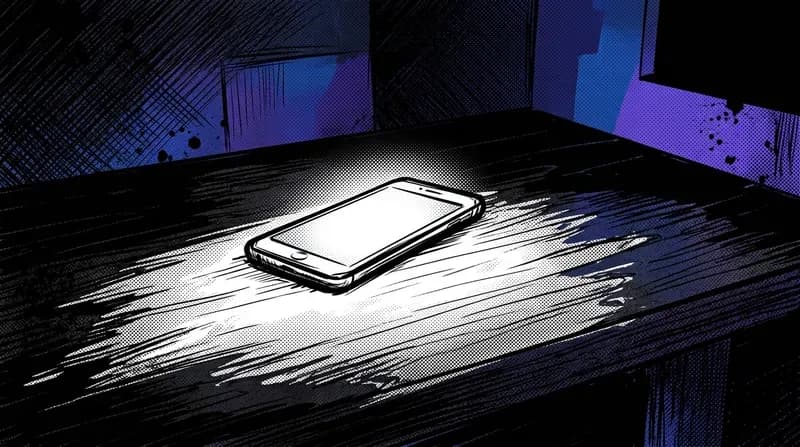
The modern attention environment is engineered for engagement and addiction. Your phone. Your feeds. The notifications. The dopamine loops designed by people whose job it is to use cutting-edge science and technology to capture as much of your attention as possible.
All this engineering has consequences: research in JAMA Psychiatry has linked time spent on social media to rising internalizing mental health problems among young people.
It's the exact same mechanism as the food problem, applied to your mind. Constant stimulation. Constant interference. An environment designed to keep you consuming, not to keep you well.
Porn is this, but on steroids. It reaches deep into your brain and hijacks some of your most primal instincts. It overloads your system, all to capture your attention and keep you coming back.
And the solution? Remove all the interference.
Now, partially this is not news to you. You already know that in order to heal your brain from the effects of porn addiction, you have to quit porn. Duh.
But the important idea here is this: even if you do nothing else, that's already doing a lot. The more interference you remove, the better off you'll be, because the faster your brain heals.
You don't have to make the healing happen. Just stop re-injuring your brain, so to speak.
As long as you stay away from porn, the healing is happening. And if you also remove social media, the healing is faster. And if you also go out into nature and get away from screens, the healing happens even faster.
The more "do nothing" you do, the better the results.
Why Nobody Tells You This
If doing nothing is genuinely one of the most powerful, accessible, free interventions available to anyone, why isn't it everywhere? Why is this article perhaps the first time you've seen it stated so clearly and so directly?
Because there's no product to sell.
How is this going to increase the GDP if people just stop doing things and that solves their problem? There's no supplement company that profits from you doing nothing. No expert you need to hire. No course you need to buy (not even mine, even though it's a really good course). No medication to prescribe. The answer is to simply stop, and stopping generates zero economic activity.
Our culture commodifies every problem into a product, a service, an expert, or a medication. When the actual answer is free, self-verifiable, and requires no belief in anyone or anything, it gets almost no cultural traction.
(This is also the reason why you don't hear much about medicinal mushrooms even though they are some of the most powerful health foods and supplements available - they can't be patented and worse, they grow in every forest. But I won't go into that today.)
That's not a conspiracy theory. It's just incentives. Nobody runs ad campaigns for "sit still and stop." Nobody funds research with a profit motive to prove that the thing you already have for free is the thing you need. The idea spreads on merit, not marketing, and merit is slower.
Try It Yourself
You don't need to believe any of this. That's the best part. The entire principle is self-testable, for free, right now, by anyone, with no signup required.
Sit down. Remove stimulation. Do nothing.
Here's what will probably happen: restlessness. Boredom. The urge to reach for your phone. A mind that wanders everywhere except here. And every time the impulse arises to do something about this, the only move is to remember why you're here. You're here to do nothing.
Let it play out. Don't fix the restlessness. Don't chase the boredom away. Don't correct the wandering mind. That's all interference. You're practicing the opposite.
After a while, check in. Compare thirty minutes of doing nothing against thirty minutes of overstimulation. Decide for yourself. Not based on what I say, or what a study says, or what a tradition says. Based on the contrast you feel in your own body and mind.
That's the test. You can run it as many times as you want. Free of charge. No belief system required.
Your Turn
I've been through long, desperate periods of depression myself. Dug myself out of that hole. The things I learned along the way are the things that make me optimistic enough to write this instead of keeping it to myself.
So here's what I want you to hear if you're deep in it right now: you are more capable than you think you are.
You're much closer than you think to taking that first step which leads to the second step which gives you momentum which then leads you to a place where you're looking back and you go wow, I can't believe how far I got.
The first step isn't adding something. It's removing something. Stop swimming upstream. The current is already carrying you. You just have to let it.
What happens if you spend thirty minutes today doing absolutely nothing?
About the Author
Shane is a serial entrepreneur with a long-standing obsession for personal development and life optimization. He has a habit of buying more books than he can ever read. During his childhood his worldview was significantly influenced by Jackie Chan movies, the Vorkosigan Saga and the writings of Miyamoto Musashi.
Shane Melaugh
There is a Better Way to Quit.
Stop relying on sheer willpower. Learn the step-by-step psychological framework that makes quitting inevitable.