Why Your Brain Craves Porn So Much (Even if You’ve Decided to Quit)
Porn addiction isn’t a character flaw. It’s your prehistoric brain doing exactly what it was designed to do, but in a modern environment that overstimulates and hijacks it at every turn.
 Shane MelaughPublished Updated
Here's something most porn addiction content gets completely wrong. It treats craving like a moral problem. Like if you just wanted to quit badly enough, the urges would cooperate.
They won't. And the reason has nothing to do with your character.
TL;DR: Your brain craves pornography so intensely because it's running 200,000-year-old software in a world filled with overstimulating screen-content. Porn exploits your mating drive the same way junk food exploits your hunger drive — by triggering the exact signals that meant "huge win" in a prehistoric world. Understanding this doesn't excuse the addiction, but it does explain why willpower alone can't fix it, and what actually can.
Why Junk Food and Porn Are the Same Problem
Your brain wasn't built for the modern world. It was built for a world that no longer exists.
We carry prehistoric hardware inside our skulls. For hundreds of thousands of years, our ancestors needed powerful built-in drives to survive: strong motivation to find food, to find a mate, to avoid danger, to belong to a group. Those drives worked brilliantly in the environment they evolved for.
Then the environment changed — radically and fast. And the same dopamine system that drove real-world behavior started getting exploited by things it was never designed to handle.
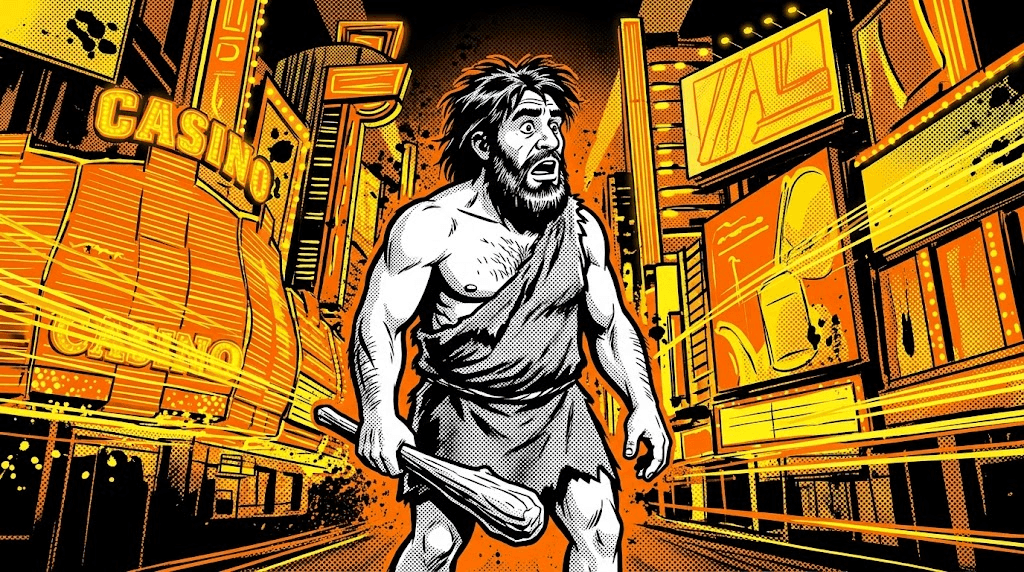
Think about ice cream. It's sweet, high-fat, and calorie-dense. Most people love it more than they probably should — and that's not a personal failing. To your prehistoric brain, sweetness signals ripe fruit. Fat signals a high-calorie food source. High calories, in a world where your next meal was genuinely uncertain, meant survival.
"I shouldn't eat that" is an entirely modern phenomenon. For most of our history, sugar fat and calories followed the rule: the more the better!
So when you eat ice cream, your caveman brain lights up. This is a massive win. Get as much of this as possible. And remember exactly how we found it. Dopamine spikes. The memory gets anchored. The craving gets wired in.
The problem is obvious when you look at it from the outside: nobody in the modern world is one missed meal away from starvation. The wiring misfires. It was built for scarcity and now operates in abundance. Weight gain, obesity, metabolic disease — these are, in part, the consequences of ancient brain hardware running in conditions it wasn't designed for.
Pornography is the exact same problem. It addresses a different drive, but it's the same underlying mechanism.
How Porn Fools the Mating Drive
Every human has two powerful biological survival drives:
- Find food
- Reproduce
One keeps you alive. The other keeps the species going. Both are wired deep, beneath conscious control, and both respond to signals in the environment.
Research on pornography as a supranormal stimulus shows how you get tricked on a neurological level: part of your brain thinks you are experiencing reproductive success when you masturbate to porn.
You haven't just stumbled on something interesting. You have, in the language of your nervous system, found a mate and procreated. The deep biological program that's been running for millennia says: yes. This is exactly what we're here for. Remember this. Do this again.
This is why understanding the evolutionary roots of the habit loop matters so much. The trigger isn't just psychological, it's primal.
You're not fighting a bad habit. You're fighting a drive that kept your ancestors alive.
The Zero-Risk Illusion
Here's the part that makes porn uniquely addictive, even compared to other forms of hyper-stimulation:
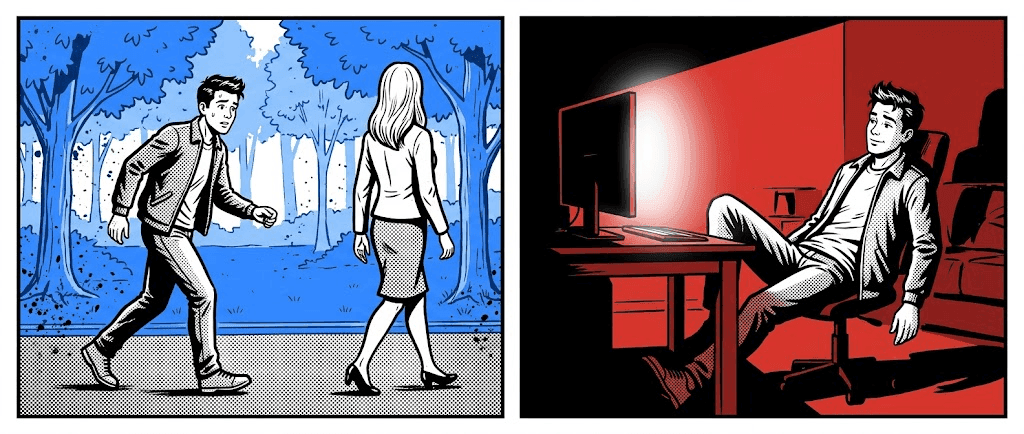
In the real world, pursuing a mate involves risk. Social risk. Emotional risk. The possibility of rejection, which feels like a small death.
And even if things go well and you find a partner, that's not the end of all your problems.
There's vulnerability and friction and conflict in every relationship, even great ones. Ask anyone who's been happily married for years: their relationship has had moments of real pain, moments of doubt and fear. Most long term relationships have almost fallen apart at least once or twice.
Your brain knows all of this. Yes, it wants to drive you towards reproduction... but it would also like to avoid pain and discomfort as much as possible.
Your ancestral wiring is scanning for the lowest-risk path to reproductive success, the same way it scans for the most calorie-dense food available with the least effort required. A dangerous hunt for a meal or a safe berry patch — take the berry patch.
Porn offers what feels like the ultimate loophole: all the reward signals of reproductive success, with zero risk.
No rejection. No conflict. No awkward first dates. No vulnerability. No difficult conversation. Endless variety, infinite novelty, and no emotional downside whatsoever.
To your primitive brain, this looks like a cheat code.
We're being incredibly reproductively successful, and it's completely safe!!
No wonder it gets wired in so fast. No wonder the craving is so intense. No wonder every stressful day, every rejection, every moment of interpersonal pain makes the urge spike — because in those moments, your caveman brain is saying here's where we can get all the reward with none of the pain. Let's go there.
Why Willpower Fails Against This
When you understand what you're actually dealing with, the failure of willpower starts to make sense.
You're not fighting a habit. You're fighting a deep biological drive that's been reinforced by what your nervous system genuinely believes are survival wins. That's not a fair fight. The part of you that knows porn is harmful is your conscious, rational mind. The part that craves it is running on far older, more powerful wiring.
This is exactly why willpower based approaches like NoFap tend to collapse under stress. Willpower is exhaustible. The mating drive is not.
One bad day at work, one relationship disappointment, one moment of loneliness... you can probably handle that. But what if they start piling up? What if the stress and overwhelm and loneliness just becomes too much? That's when the older, deeper system wins over the newer, rational one.
The answer isn't to try harder with willpower. But you already know that, because you've already tried it a bunch of times.
The Reframe: Shallow Stimulation vs. Real Depth
The problem is basically that your brain is preferring the wrong things.
So how can you change what your brain craves?
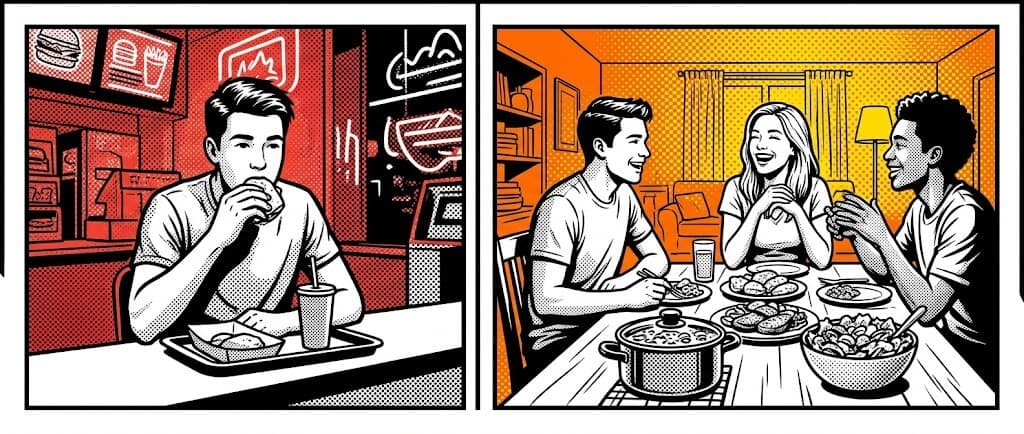
Here's the comparison I find most useful: people who successfully manage their relationship with junk food don't do it by hating ice cream.
Everyone craves it. The difference is that people with good diets have found something better.
Not better in terms of immediate stimulation — junk food will always win that race. Better in terms of depth.
A home-cooked meal you made yourself, shared with people you care about, gives you an experience junk food simply can't replicate. The pride in doing it well. The connection of sharing it. The satisfaction that lingers rather than crashing into a craving for more.
The same reframe applies to pornography. Porn will always be more stimulating than real intimacy. More novel. More intense. More immediately gratifying. You cannot win the stimulation competition.
But the good news is: you don't have to.
You can develop a preference for depth.
Real intimacy, especially with someone you have a genuine emotional connection with, gives you something porn never can. The connection. The presence. The feeling of being truly seen by another person and fully seen in return. And the good news is that your brain is not locked in place — you can genuinely change what you prefer. Once exposure to the artificial stimulus drops away, the brain recalibrates. Natural rewards start triggering appropriate responses again. Real intimacy starts to feel genuinely rewarding rather than pale by comparison.
That recalibration takes time. But the more you invest in real connection, the more clearly you'll feel the difference — and the easier it becomes to prefer depth over stimulation.
Porn is Not About Pleasure
The mating-drive hijack explains why you get hooked in the first place. But there's a second layer that explains why it's so hard to quit: porn is a coping mechanism.
Honestly, this is probably the piece most people miss. Ever notice how the craving spikes hardest when:
- You're stressed
- You feel lonely
- You're anxious
- You just got rejected
- You're processing a difficult experience
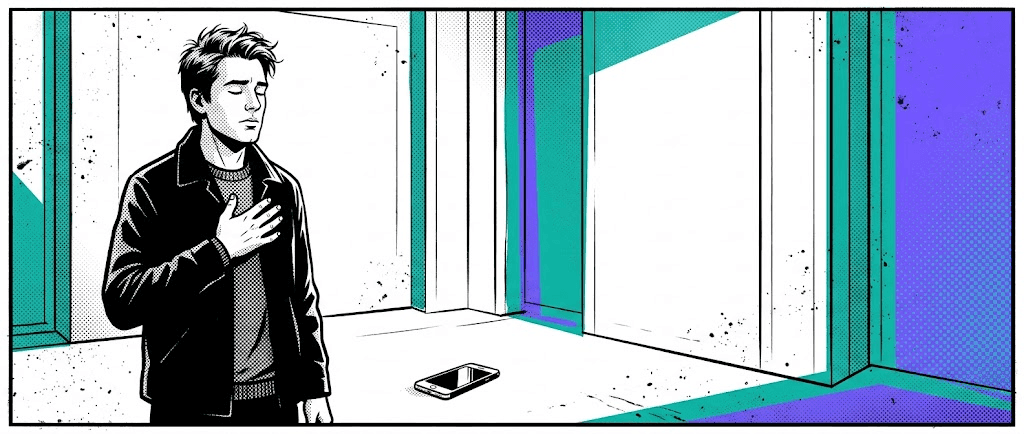
It's not that you feel horny and that makes you reach for porn. More often than not, it's a negative feeling you're trying to escape.
And your brain has learned to reach for porn as a tool. A way to numb out. A way to get relief from whatever you're trying not to feel.
I found this with food, too. For a long time, eating was one of my go-to responses when I felt stressed or overwhelmed. I'd have these binge eating experineces and then wonder: why the heck did I do that? I just kept stuffing myself even though I wasn't hungry at all!
Luckily, I eventually realized that exercise is a much better way for me to deal with stress, overwhelm etc.
Moving my body and working up a sweat genuinely resolved the tension in a way stuffing myself with food never did. And with that, the compulsive eating started to fade.
Note that I wasn't forcing it. It was more like I finally started paying attention and as a result the better option became obvious.
The same thing works with pornography. Building a toolkit of genuinely effective coping strategies — exercise, breathwork, meditation, introspective writing — doesn't just give you something to do instead of watching porn. It addresses what you were using porn to manage in the first place. And once you've felt what it's like to actually process a difficult emotion rather than escape it, you start losing interest in the escape route.
How to Actually Get Unhooked
Understanding the evolutionary mechanism behind your addiction is helpful, but it won't magically solve everything.
What we need to do know is apply this knowledge into practical steps. Here's how you can change your habits in a way that makes your inner caveman happy, too:
Prefer depth over stimulation
This is the long game, and it starts with investing in real intimacy and real connection rather than treating them as obviously inferior to the alternative. They're not inferior. They're operating in a different dimension entirely. The more you experience the depth side, the less satisfying the shallow side becomes.
A big part of this is paying attention. Notice how you really feel after a junk food meal vs. a healthy meal.
Notice how you really feel after a porn session. And then seek out the real thing and see how that feels. Any form of the real thing is a win. Could be just a conversation, face to face with another person. Or asking someone out (and noticing how good it feels to do that, even if you don't get a yes).
Replace porn with healthier coping tools
Every time you use porn to escape a difficult emotion, you're training your brain that this is what difficult emotions require. Sitting with discomfort rather than numbing it is its own trainable skill. And it's far more effective for quitting porn than you might think.
But you don't always have to confront the discomfort directly. You can make a lot of progress by swapping out unhealthy coping mechanisms with healthy replacement habits. Meditation, exercise, writing — these build your tolerance for difficulty. Which means the craving, when it comes, doesn't hijack you the way it used to.
Work the underlying wound
Under most persistent porn addiction is something being avoided. Fear, loneliness, shame, unprocessed pain. The addiction is often managing something that hasn't been looked at directly. The QuitByHealing Program works through exactly this — not just the surface behavior, but the underlying wound that keeps the behavior anchored.
Your brain craves porn so intensely because it's doing what it was designed to do. But you're not stuck with that design forever. The same neuroplasticity that wired the craving in can wire it out.
That process starts the moment you stop treating this as a willpower problem and start treating it as what it actually is: a brain that needs a better environment to find its way back.
What coping mechanisms have you actually tried when the urge hits? That's usually where the real work begins.
About the Author
Shane is a serial entrepreneur with a long-standing obsession for personal development and life optimization. He has a habit of buying more books than he can ever read. During his childhood his worldview was significantly influenced by Jackie Chan movies, the Vorkosigan Saga and the writings of Miyamoto Musashi.
Shane Melaugh