Fix Your Sleep to Fix Your Habits (and Heal Your Brain)
For most of my life, I thought tossing and turning for two or three hours before falling asleep was normal. Like, that's what you did. You got into bed, you lay there, mildly frustrated and then eventually you drift off.
And for a long time, I had a go-to "fix" for when I couldn't sleep: porn. I know I'm not alone with this. It's just such an easy way to release tension and get into that drowsy state.
Today, I'm going to share with you exactly how you can fix your sleep in order to achieve 2 things:
- You no longer need porn to fall asleep
- You have a healthier, stronger brain and you recover faster
The better you sleep, the easier it is to build good habits and break bad ones. Most guys who try to quit porn never look at lifestyle factors like this, but the impact is huge.
To bring you this article, I read every book on sleep I could find, did dozens of experiments on myself, and wore an Oura ring for years to gather sleep data.
Here's the short version of everything I learned: most sleep advice is noise. There are two things that account for almost all of your sleep quality. Fix those two things first, and the rest barely matters.
TL;DR: Sleep quality is driven by two foundational factors: light exposure (which regulates your body's master clock) and the skill of falling asleep. Every other sleep hack stacked on top makes a fraction of the difference.
Why Sleep is Hugely Underrated
Sleep is a force multiplier for everything in your life. Bad sleep makes all the bad things in your life worse, and good sleep makes all the good things in your life better.
For example, did you know that the highest levels of growth hormone and muscle protein synthesis in your body happen during sleep? No matter how hard you work at the gym, most of the actual muscle building happens while you sleep.
Memory consolidation and learning also happen during sleep. Which means that the worse you sleep, the dumber you get (yes, that's an oversimplification, but I had to make sure that even the sleep deprived readers get it).
And it gets worse: people who consistently sleep less show significantly higher rates of obesity and metabolic disorders like type 2 diabetes. Poor sleep is also closely tied to anxiety, depression, and chronic stress.
The list goes on...
Let's cut to the chase: not sleeping enough doesn't just make you tired. It also makes you weak, fat, dumb, sick, and sad. All at once.
And All of That is Before We Get to Late Night Porn Use
As if everything so far wasn't bad enough, there's one more problem we need to talk about: late nights are the dopamine addict's greatest weakness.
You lie in bed, you can't fall asleep and what happens next?
You reach for your trusty 'ol dopamine dispenser. Your good pal Mr. Smarphone who you can always turn to when you need to avoid the potentially catastrophic scenario of having to sit with your own thoughts for a few seconds.
And then, the doomscrolling starts. You go back to the site you promised yourself you wouldn't. You end your day doubling down on your worst habits, and the next day you feel awful.
All of this makes it harder to sleep the following night. Which makes the phone even more tempting.
Welcome to yet another self-destructive vicious cycle (I bet you didn't have enough of these in your life yet).
For anyone working on breaking compulsive digital habit loops, improving sleep can't be treated a side project.
Why Most Sleep Hacks Don't Actually Move the Needle
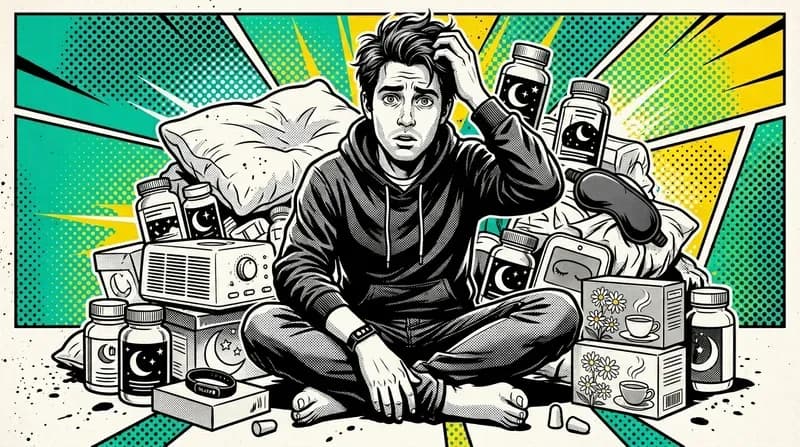
I've read way too many books, studies and articles about sleep optimization. And if you look online, you'll find endless lists of sleep hacks:
- Ideal bedroom temperature
- Eye masks
- Supplements
- White noise
- Pink noise
- Binaural beats
- Nature sounds layered with binaural beats and pink noise
- Actually scratch all that and wear earplugs!
- More supplements
- Memory foam mattress toppers
- Ergonomic pillows
- Actually scratch that and sleep on a hard mattress on the floor!
- Herbal teas
- Even more supplements
- Sleep tracking wrist bands, rings, head bands, mattress inlays and more
- Really a suspiciously large amount of affiliate links to supplements (I wonder why...)
And I have a confession to make: this list is what I know from boomer-internet. I haven't even dared look at what sleep hacks people are recommending on TikTok. I can only imagine the horrors.
Anyway, here's the thing about all these sleep hacks: most of them make a tiny difference, at best.
But if each one makes a small difference, then it's still worth it, right? Just stack 'em all up and it turns into a big difference!
Well, not really.
The truth is that there are 2 factors that make such a big difference to your sleep quality that almost nothing else matters in comparison.
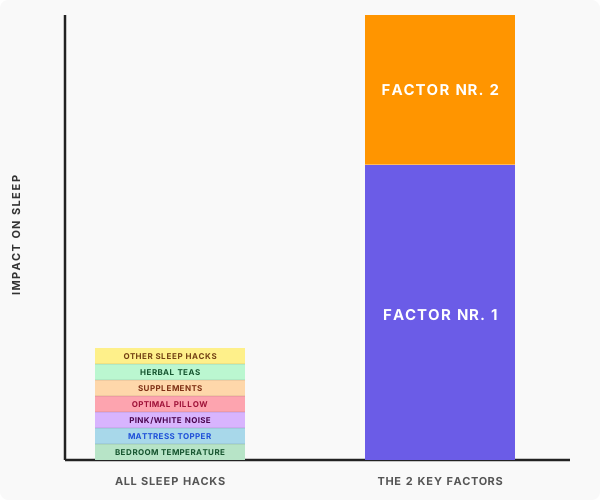
And what's worse, both of these are free! No affiliate links for me! (crying emoji)
So what are these two factors?
Factor Nr. 1: Light Is Your Body's Master Clock Signal
Light hitting your eyes is the single most important factor for sleep quality. Nothing else comes close.
Your eyes contain specialized receptors finely tuned to detect light temperature and brightness, and these receptors regulate your body's circadian rhythm.
Basically, your body uses your eyes to "set the clock" because for all of your evolutionary ancestors, this worked great! If you lived at any point between about 100,000+ and about 150 years ago, you'd wake up in the morning and you'd see warm, low-angle light from a rising sun.
That's your body's wake-up signal. It triggers a cascade of hormonal changes that switch you from sleep mode to active mode.
Then, as the day progresses, you're under bright midday light. Then toward evening, you get another bout of warm low-angle light as the sun sets. Your cue to wind down. After dark, dim warm firelight for an hour or two. Then sleep.
This is the simple logic your body works on:
- Low angle warm light to rev up the engine
- Bright overhead light = awake, alert
- Low angle warm light to wind down
- Zzzzzz
Simple.
Except you're not living 35,789 years ago, you're living right now. And right now, this system is totally screwed.
How the Modern World Throws a Wrench Into Your Body Clock
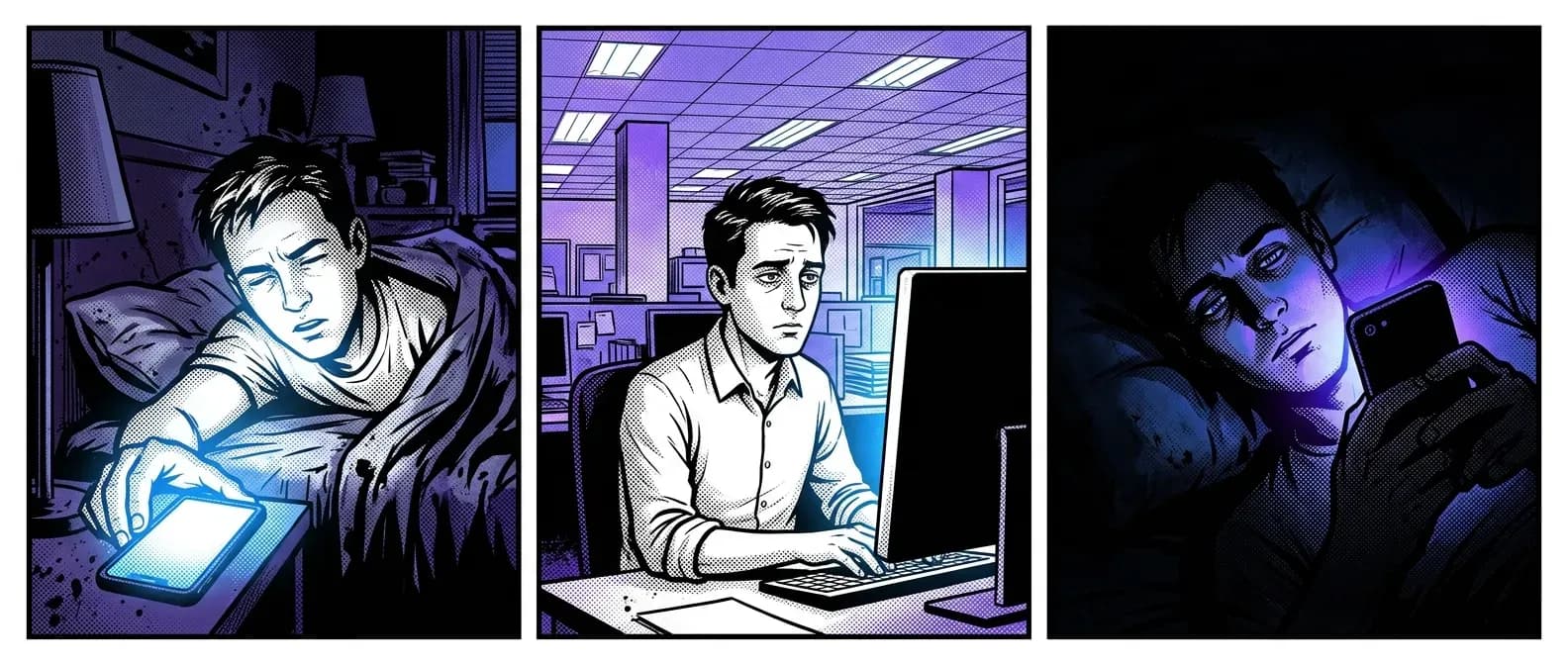
You wake up and immediately get a blas of artificial blue light from your phone screen. It's too bright, too soon and too much unlike the sunlight your body is expecting.
We're off to a bad start.
Even worse if your bedroom is illuminated at light by:
- Blue or green LED lights from a WiFi router
- Outside street lights leaking in through cracks in the curtains
- Lights from microwave clock displays, aircon temperature displays and similar.
- Idle LED lights (like the red light on a turned off TV)
- Light from a running TV or screen because you fell asleep to Netflix again(!!!)
Now, your body is doubly confused because it never got the darkness it expected, either.
And we haven't even gotten out of bed yet!
The next problem is: most of us spend most of our days indoors. Here, we once again get artificial light instead of natural sunlight.
And then, instead of the world around us gradually getting darker as night approaches, we just switch to different lights: indoors, everything stays brightly lit. Outdoors, it's only marginally better: street lamps, billboards, headlights from passing vehicles make the world around us unnaturally bright.
And of course, this whole time, we're still staring at screens. Our eyes get relentlessly blasted with light, pretty much regardless of what time of day it is.
Result: your body clock is totally confused. Your brain never gets a clean "it's morning" or "it's time to sleep" cue. Just constant visual noise.
And here's the cherry on top: research on how sleep loss affects the brain shows how quickly this disconnects the prefrontal cortex (the smart, long-term thinky part of your brain). Meaning: all of this is making you more impulsive. If you're dealing with addictive habits, that's the last thing you need late at night.
How to Fix This Mess
Now that we understand the problem, we can design a highly effective solution:

Step 1: See Sunlight in the Morning (if you can)
Go outside shortly after sunrise, before you look at any screens. I go for a walk in the morning and often head to a park where I also do some light exercise.
I take my shirt off so that I get natural light on my skin as well as in my eyes.
This is an elite way to start your day in general. And it gives you the "it's morning, time to wake up" cue your body clock has been waiting for. It sets every downstream system for the rest of the day.
Seriously, do not underestimate how effective this is.
And btw, if you live in a place where there are long, dark, happiness-draining winters, you can work around that problem, too.
Step 2: Avoid Blue Light in the Evening
Turn down your screen brightness when it gets darker outside. Honestly, this is one of those things that seems so simple, but matters so much.
I can't tell you how often someone shows me something on their phone in the evening and my eyes just get absolutely nuked by the light coming off their screen.
Why on earth would you need your screen to be this bright?!?
Turn the brightness down and you'll quickly get used to it and realize you needed roughly 10% as much light to see what's on your screen. Your eyeballs will thank you.
Also, turn on night shift mode (you know, the thing that makes your screen go all orange) and have it activate automatically. Set it to kick in relatively early, not just right before bed.
Night shift is good, but it doesn't do enough. What I do on top of that is wear blue-light blocking glasses once it gets dark. Make sure you get the ones with a dark red tint. Not the yellow ones and certainly not the transparent ones that claim to block some blue light. Go full red.
Yes, you'll look like a dork but it's worth it.

Step 3: Live in the Dark at Night
After dark, no overhead lights. I use only warm, dim, indirect lighting in my apartment. I also avoid screens altogether for 90 minutes to 2 hours before bed.
This is what I call "living in the dark". You just get used to the idea that at night, it's well... dark. It's easy to get used to because that's exactly what your brain and body expect.
This time period is great for reading, writing, stretching, meditating, or having long conversations.
Yes, this is very different from how you're probably used to spending your evenings (let me guess: after working all day looking at medium screen, you spend your evening watching stuff on big screen before some more little screen time in bed?), but it'll make you feel so good, you won't ever look back.
This is also where building better replacement habits for your evenings pays off. The phone doesn't have to fill that space.
Factor Nr. 2: Falling Asleep Is a Skill You Have to Relearn
Most people treat sleep as passive. You get in bed, you close your eyes, and it either happens or it doesn't. If it doesn't, you try repositioning, checking the time, doing mental math about how many hours you have left if you fall asleep right now.
Actually, who am I kidding? When you don't fall asleep, you reach for your phone, for a bit more doomscrolling.
What nobody told you is that your troubles falling asleep are quite literally a skill issue. You struggle because you're not good at it. And you can get good at it.
This was me, btw. I sucked at falling asleep. Here's how I taught myself this skill:
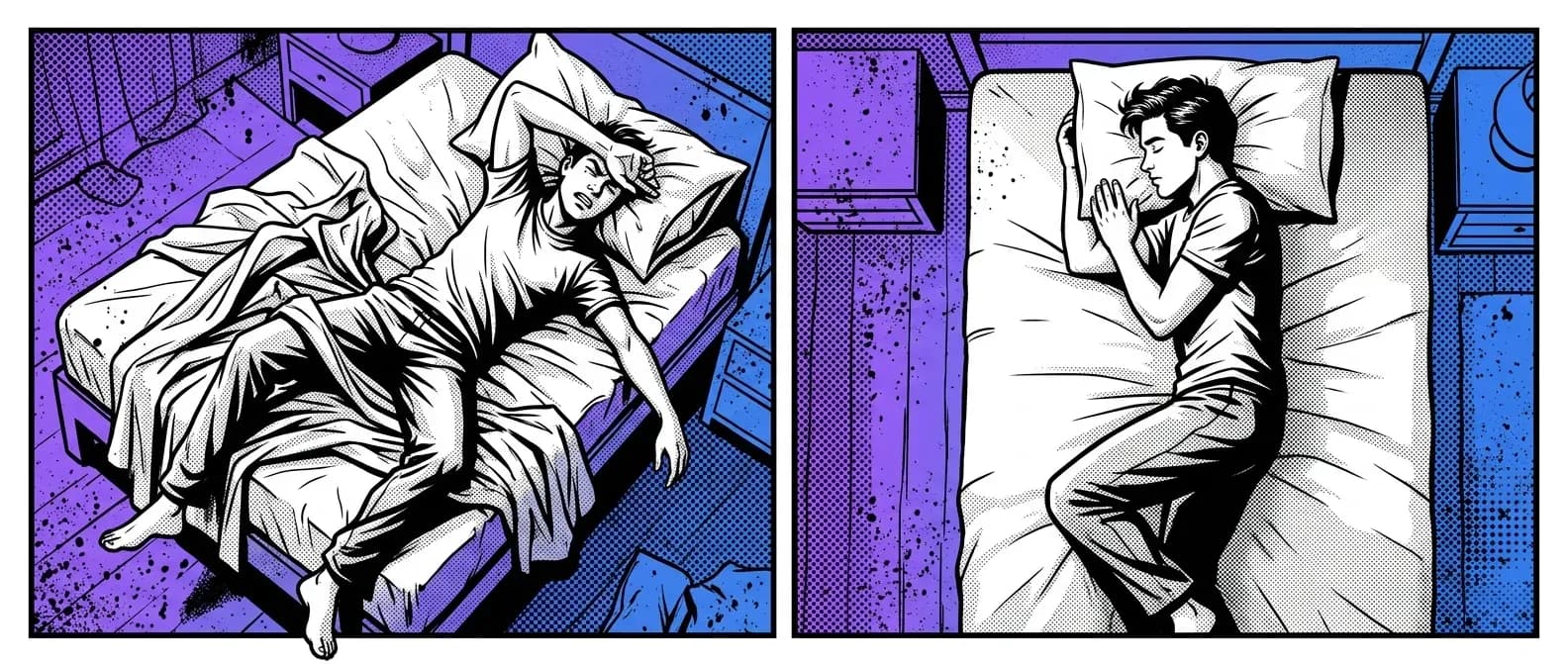
Step 1: Get Into Your Comfortable Position and Stay There
You already know what position you end up sleeping in. All the tossing and turning isn't going to change that or suddenly make your ratty old pillow more comfortable.
So just get into that position from the start and then stay there.
At first, you'll hate this. Your mind will try to negotiate.
"Let's try a different position."
"Did I actually fall asleep in this position before?"
"Maybe I should open the window/change the ac temperature, reach for my phone..."
This is where you have to just stay put. You have to show your mind who's boss.
And then something incredible happens: when your mind realizes that you're being stubborn and that it won't get extra stimulation or extra distraction, it just goes for the most reasonable available option: sleep.
This is like a toddler who just gives up on throwing a tantrum because it's not working.
I got this trick from the book Sleep by Nick Littlehales. He used this to help athletes get better sleep and thus better performance.
Step 2: Breathe Slowly and Steadily
Focus on long, slow breaths. Put your attention specifically on extending the exhale. Don't force your breathing, just try to very gently slow down your breath.
You do this as you stubbornly remain in your sleeping posture.
This type of breathing directly regulates your nervous system and helps shift you from alert mode into sleep mode.
It's also a great distraction from your mind's negotiation tactics. You just ignore it and focus on your breath, instead.
Step 3: On Every Exhale, Let Your Body Relax
On each exhale, feel your body get a little heavier. Notice the bed supporting you, and let yourself sink into it a bit more with each breath.
Allow yourself to feel tension draining from your muscles as you do this.
If you have a busy mind (a lot of guys do), you can use the word relax as a soft anchor. Think it silently on every exhale.
Idk if this goes without saying but you can't force your body to relax. It's more like an invitation. You're allowing yourself to relax more on each exhale.
Step 4: Commit to Sleep and Reframe the Experience
When you lie there and can't immediately fall asleep, the usual response is anxiety. You follow random trains of thought. You worry about tomorrow. You remember something embarrassing from two years ago. And then: this isn't working, I should check my phone, how many hours do I have left?
This is expected. You're bad at falling asleep. You're practicing so you get good at it. Nothing to panic about, here.
One reason your brain loves to negotiate is because you've been spoiling it with overstimulation. Your brain is hooked and looking for any excuse to get more of that deliciously addictive screen time.
We gotta wean it off. So here's the alternative: give yourself only two options. You're going to:
- Fall asleep or
- Lie in your comfortable bed and enjoy the feeling of deep relaxation
Notice how both of these options are pleasant and restful and easy.
There's nothing stressful about lying in bed. It's actually one of the more pleasant things available to you. No obligations. No expectations. Nowhere you have to be. The pressure of the day is off. Even if sleep doesn't come immediately, you're resting in warmth and comfort, and that's genuinely good. So no matter what happens, you just focus on the process and enjoy the time.
When you commit to this fully: no phone, no position changes, no mental commentary. Sleep comes much faster. And because the anxiety loop is gone, you sleep deeper too.
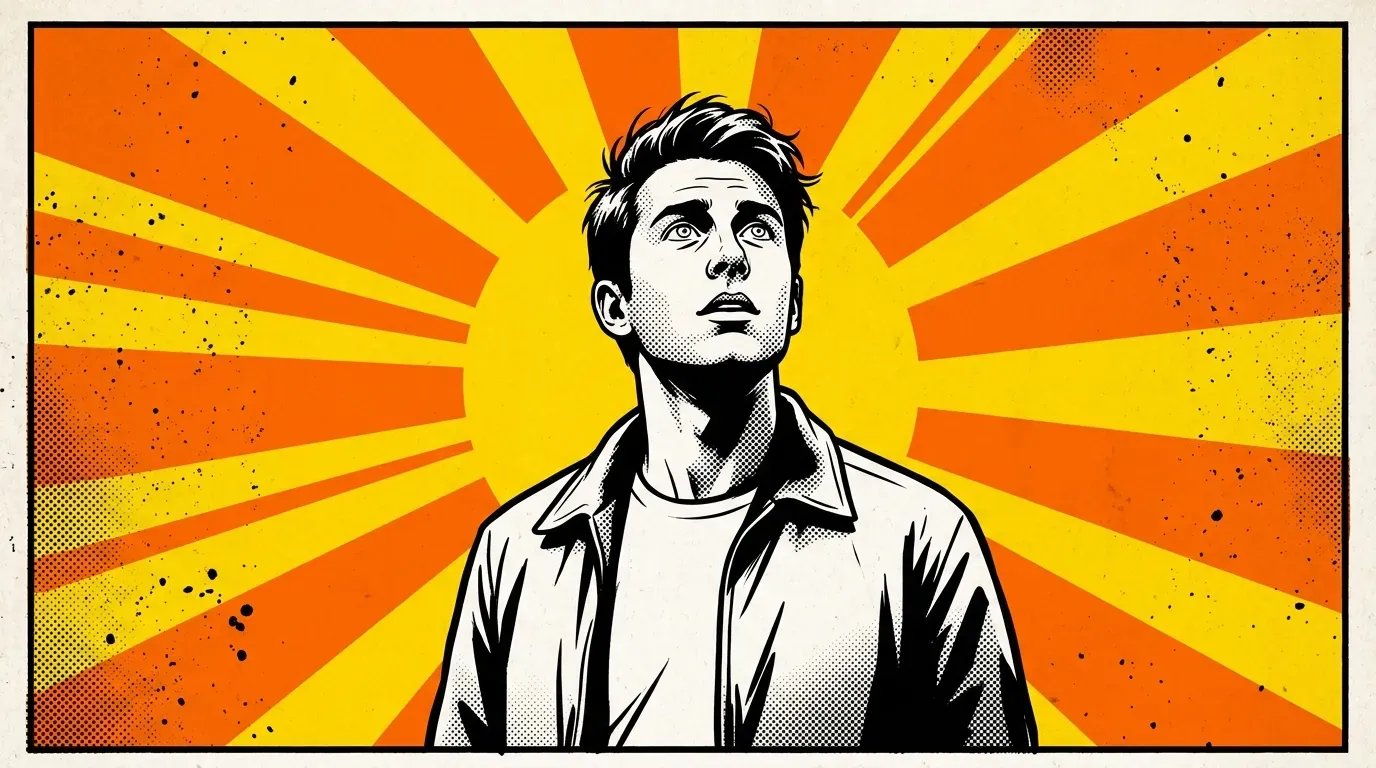
Good Sleep is Better than You Expect
There you have it: the two factors that actually make a difference to your sleep quality, more than every sleep hack combined.
The first few nights might be uncomfortable. If you've spent years reaching for your phone the moment you can't sleep, committing to stillness will feel strange. But it doesn't take long to get used to this new way of sleeping.
Within a week or two, you'll be in disbelief at how much you sabotaged your sleep for most of your life.
And you won't want to go back because sleeping well feels GOOD. It gives you more energy, more focus, gets you better gains in the gym, makes you feel sharper and more alive, gives you a performance gain over all the people who still suck at sleeping... what's not to love?
If late nights are a recurring trap for you (and for most guys dealing with compulsive digital habits, they are), fixing sleep is one of the highest-leverage things you can do. And I just handed you the keys to it.
Give it two weeks and see what happens.
About the Author
Shane is a serial entrepreneur with a long-standing obsession for personal development and life optimization. He has a habit of buying more books than he can ever read. During his childhood his worldview was significantly influenced by Jackie Chan movies, the Vorkosigan Saga and the writings of Miyamoto Musashi.

Shane Melaugh
There is a Better Way to Quit.
Stop relying on sheer willpower. Learn the step-by-step psychological framework that makes quitting inevitable.