What Age Where You When You Discovered Porn? The Answer Changes Everything About Recovery
The question I get more than any other is some version of: "How long will this take?"
How long until the cravings fade? How long until the brain heals? How long until things feel normal again?
The only honest answer is the one nobody wants to hear: it depends.
But the good news is: we know what it depends on.
And on of those things is age. More specifically: how old you were when porn became a habit, and how old you are now.
TL;DR: The younger your brain was when porn became a habit, the more deeply the wiring went in. The older you are now, the more effort it takes to undo. Neither factor makes recovery impossible, the brain can change at any age, but together they determine how much strategy and effort you need to deploy to get fully porn free.
At What Age Did You Start Watching Porn?
The single biggest predictor of how hard recovery is isn't how much porn you've watched or how extreme the content has gotten. It's how old your brain was when the habit formed.
Here's why:
Young brains learn fast. Think about how quickly young children learn everything, from walking to talking to understanding the world.
Every behavior you repeat trains your brain to run that behavior more efficiently, and that training effect is dramatically stronger when you're young. A 12-year-old brain is operating at peak neuroplasticity. The habit of using porn formed at that age doesn't just get stored somewhere shallow. It gets wired in deep.
Here's data from the Knowingless survey, one of the largest datasets of its kind:
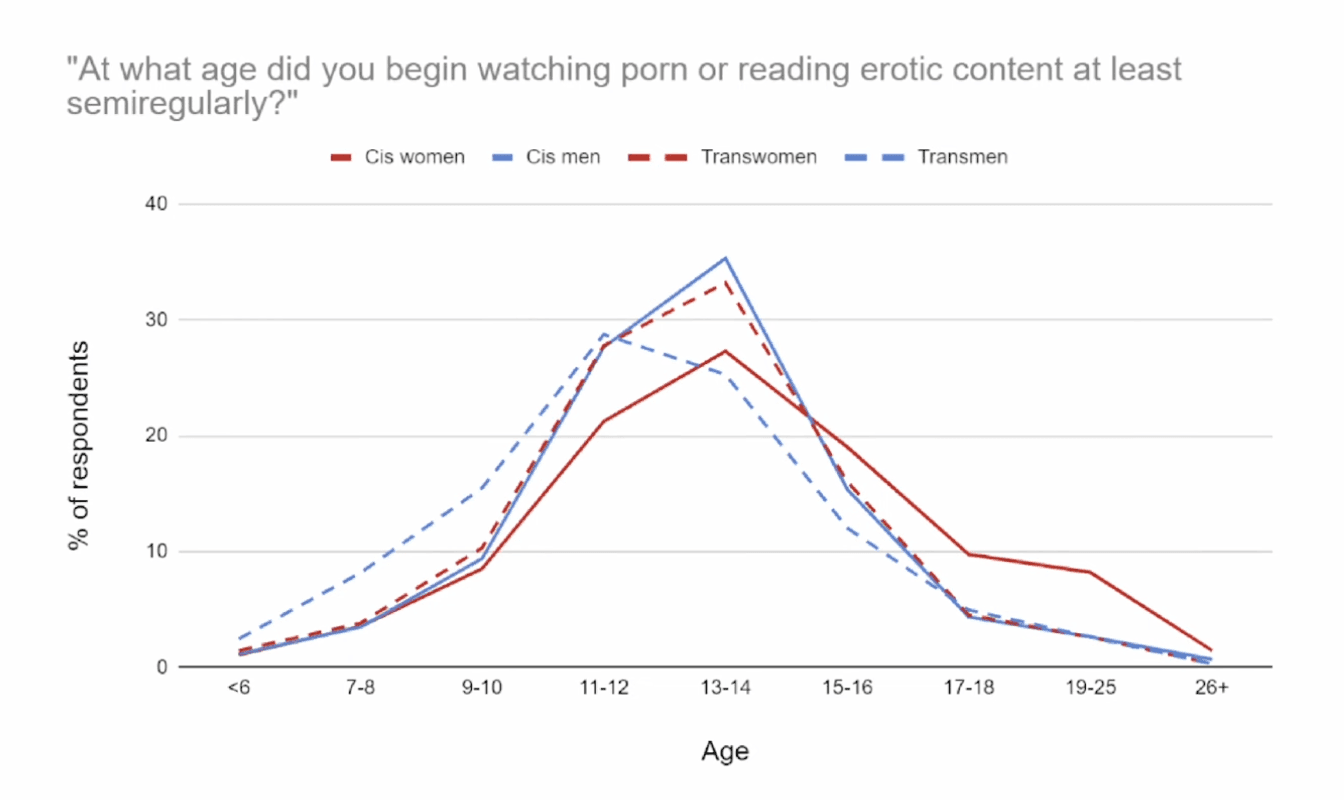
What we can see here is that the majority of men started using porn between 11 and 16. The peak is around 13-14. And it's quite rare for someone to start watching porn after 17-18 (and this is mainly because by then, almost everyone is a user).
This also tracks with what I see among men I work with. Most discover porn at a young age, usually preteen or early teen.
This is bad news because it means you encountered this hyper-stimulating, addictive thing at a time when your brain was especially vulnerable.
What Does Neuroplasticity Mean for Your Recovery?
Neuroplasticity is the term used for your brain's ability to change and rewire itself. High neuroplasticity means: your brain changes quickly, you learn easily.
This is a key mechanism in any kind of behavior change and habit formation.
The older you get, the lower your brain's neuroplasticity. Here's an illustration from a Harvard study on the matter:
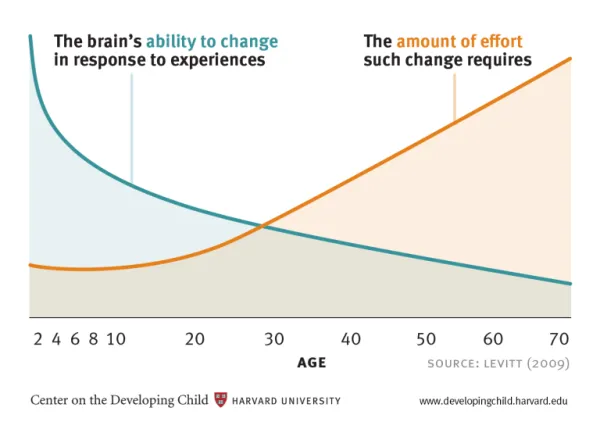
Until not long ago, the scientific consensus was that plasticity basically ended around 25. After that, the thinking went, you're stuck with the brain you have. If you formed an addiction before then, you could manage it, but you couldn't fundamentally change it.
That turned out to be wrong. Research on neuroplasticity and substance use recovery has consistently shown the brain retains the ability to rewire throughout adulthood. The capacity doesn't flatline at 25. It declines as we age but crucially, it never reaches zero.
The catch: look at the other line in that graph. The effort required moves in the opposite direction. As raw plasticity decreases, the work needed to produce change increases.
One more thing worth noting: that declining curve is an average, it's not set in stone. Indivdual differences can be significant. And there are things you can do to keep your brain young and healthy: lifestyle factors likeexercise, sleep, nutrition and stress levels all play a role.
What Predicts Your Recovery Timeline?
When someone asks me "how long will this take?", it really breaks down into 3 questions.
Question 1: How old were you when you started?
This is the depth variable. A habit formed at 12 is wired more deeply than one formed at 19. Not because you were weaker at 12 — because that's what neuroscience tells us about habit formation during different developmental windows. You were exposed to something very powerful at the worst possible time.
Question 2: How old are you now?
This matters because the it tells us two things:
- How long you've been using porn (loner = more deeply ingrained habit)
- How neuroplastic your brain is right now (higher neuroplasticity = easier behavior change)
A few scenarios to illustrate:
Started at 12, now 16? Four years of exposure, brain still at high plasticity. This is a good scenario. Although you started young, you haven't been exposed for that long AND you're still young enough to have behavior change come easy.
Started at 9, now 25? This is trickier. More than half your life with this habit and you started when your brain was super vulnerable. Just quitting and hoping for the best probably isn't going to cut it. But you still have the wind at your back.
Worst case: you started young and are now in your 30s, 40s or older. This is going to require a lot of effort!
But I want to be clear about something: no matter how you answer these questions, you can heal. I have clients who quit at 50+ years old, after a lifetime of use.
And my own starting conditions weren't great either. I discovered porn when I was 13 and I didn't quit until my 30s!
Question 3: what strategies are you using to quit?
This whole topic of brain plasticity comes down to one thing: strategy.
Many guys try NoFap or similar willpower based approaches to quitting and then wonder why it never works.
You now undestand the answer: if you haven't been using porn for very long and you're still young, then "just quit, bro" might actually work for you.
But if you've been exposed for longer, from a youger age and you're no spring chicken anymore, just trying to quit won't cut it. That's what everyone learns the hard way, when they find themselves in an endless relapse cycle.
What you need in this case is good strategy. With the right approach, you can heal your brain. And you can even do it quickly. This is the whole reason QuitByHealing and our proven 21-day program exist.

What Good Strategy Looks Like
From my experience working with clients, the most effective strategy addresses multiple aspects.
It's not enough to only look at addiction from a neuroscience and behavior change lens. And it's not enough to treat the addiction as a completely isolated issue, as if it wasn't related to everything else in your life.
This is why I developed the 4 Pillars:
Pillar 1: Habits
This is the behavior based part. Understand how habits form and how addiction affects your brain. Then deploy the right tools for the job. For example: changing your context and developing healthy replacement habits.
Pillar 2: Awareness
Without awareness, you'll always be stuck in a relapse cycle. Awareness is the skill that allows you to hit PAUSE before you relapse. And it's the key skill that makes the next step, Healing, possible.
Pillar 3: Healing
Healing is the process of addressing the emotional root causes of your addiction. It's learning to sit with your discomfort instead of always running away from it.
Pillar 4: Integrity
The final pillar is the point of it all: your struggles with porn addiction are calling you to something greater. Integrity is about embracing that calling. About accepting the quest and becoming a man you can be truly proud of.
Invariably, the addiction comes from a lack in your life. A lack of purpose, a lack of connection, a lack of confidence. The work of recovery asks you to "clean up" and doing this work is how you well and truly leave this chapter of your life behind you.
It's Not Too Late
The most important takeaway here is this: the brain's ability to change never goes to zero. A 40-year-old man who has been addicted since he was 9 is in a different position from a 20-year-old who started at 15. The work looks different. It will take more time and more deliberate strategy. But the same neuroplasticity that wired the habit in can be used to wire new patterns in.
What changes isn't the destination. It's the distance and the road you need to take to get there.
If you're in the harder part of the graph, if you started young, been at this for a while, tried just quitting and it hasn't worked, don't worry. You've found the right place to give yourself a real advantage. And my work has shown over and over again: you CAN quit, at any age.
No matter when you started and what age you are now, the same is true for planting a tree and quitting porn. The best time to do it is 20 years ago. The second best time to do it is right now.
About the Author
Shane is a serial entrepreneur with a long-standing obsession for personal development and life optimization. He has a habit of buying more books than he can ever read. During his childhood his worldview was significantly influenced by Jackie Chan movies, the Vorkosigan Saga and the writings of Miyamoto Musashi.

Shane Melaugh
There is a Better Way to Quit.
Stop relying on sheer willpower. Learn the step-by-step psychological framework that makes quitting inevitable.