How to Create a Strong WHY to Stop Relapsing

For years, I had a quiet sense in the back of my mind that I should quit porn. I knew it was a harmful habit. I'd encountered enough ideas about it to think, "yeah, this is probably worth stopping."
That vague sense sat with me for a long time. I mean, years.
But I never actually quit. Nothing changed until I actually sat down and took a real close look at what I was doing.
I had to come to my own conviction and dvelop a real reason to quit. A reason that actually meant something to me.
Everything before that was just background noise.
TL;DR: Most men who relapse aren't failing because they're weak. They're failing because they're working from a vague, borrowed reason that was never strong enough to hold up under real pressure. A strong WHY has two requirements: you have to genuinely believe it, and it has to matter to you emotionally. Without both, the urge wins every time.
You Know Your Should Quit, But It Never Sticks
One of the foundations of quitting porn is to create what I call a STRONG WHY.
Why exactly do you want to quit? If you don't have a really good answer to this question, you'll always find yourself relapsing.
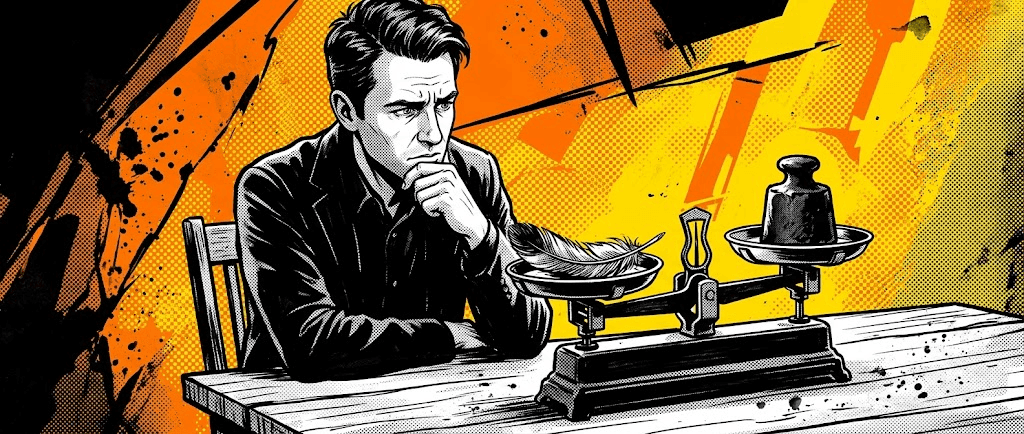
Think of it like this: when a strong urge hits, your brain runs an internal negotiation.
On one side of the table: the pull of the addiction. They're making their case.
"It feels really good."
"It will give you instant relief from these uncomfortable feelings."
"It will never reject you or judge you."
"Just one more time won't make a difference!"
On the other side of the table: your reasons to quit.
If all you got is "well I guess it's kinda bad for me?" then you've already lost.
A strong WHY is a competing force, something powerful enough to hold you steady when the addictive pull is at its strongest. Most men never build one, and then they wonder why they can't escape the relapse cycle.
If your reasons are vague, secondhand, or emotionally flat, they lose every time.
What a WEAK WHY Looks Like
This is unfortunately what most men come to me with when we start working together.
Usually, they've watched some content, absorbed a few ideas and it's kind of a jumble in their minds.
"It's just something I shouldn't do."
"I don't want to disappoint my girlfriend again."
"I heard it's bad for my testosterone levels, I think?"
These sound like decent reasons, but there's no backbone.
And what happens when a strong urge comes along
The weak WHY surfaces: Wait, my reason. It's... testosterone? Do I even have low testosterone? Your urge response toolkit needs more to work with than that.
It doesn't just fail. It fails fast.
What Makes a WHY Strong Enough?
In short, two things:
- You have to believe it
- You have to feel it
Both matter equally, and both have to be present at the same time. A WHY that's intellectually convincing but emotionally flat won't hold. A WHY that feels urgent but falls apart under scrutiny won't hold either. You need both working together.
Believe
Believing it means your reason holds up to scrutiny. Your WHY can't be built on a claim you've never seriously investigated, because the moment you're looking for an excuse to relapse, all kinds of doubts creep in.
Second-hand reasons don't work. What typically happens is that you see some content online. Someone says "real men don't watch porn" or "porn is bad for your mental health".
At first, those seem like good enough reasons to quit. But hold on: why do real men not watch porn? And does quitting porn make you a real man, or is there more to it? And what exactly does porn do to your brain? In what way is it bad for your mental health?
If you don't have clear answers, you don't have a strong why.
And here's the thing: I can't create a strong why for you, because we all care about different things. This is where the second factor comes in:
Feel
Feeling it means it genuinely matters to you. This is why you can't borrow someone else's WHY. If your friend's strongest reason is that porn destroyed his marriage, and you're 23 and have never been in a serious relationship, that reason doesn't land in your chest the same way. You can understand it intellectually. You can't feel it. And feelings are what hold you together when an urge is pushing back hard.
Maybe the thing that matters most to you is to build good habits, be mentally strong, improve your focus...
Maybe something that really touches you is the idea of being a good, virtuous man, a good role model.
Maybe you want to be more pious, closer to god.
Whatever it is, you have to find the things that resonate most with you and make those part of your why.
Let's Talk About NoFap Superpowers...
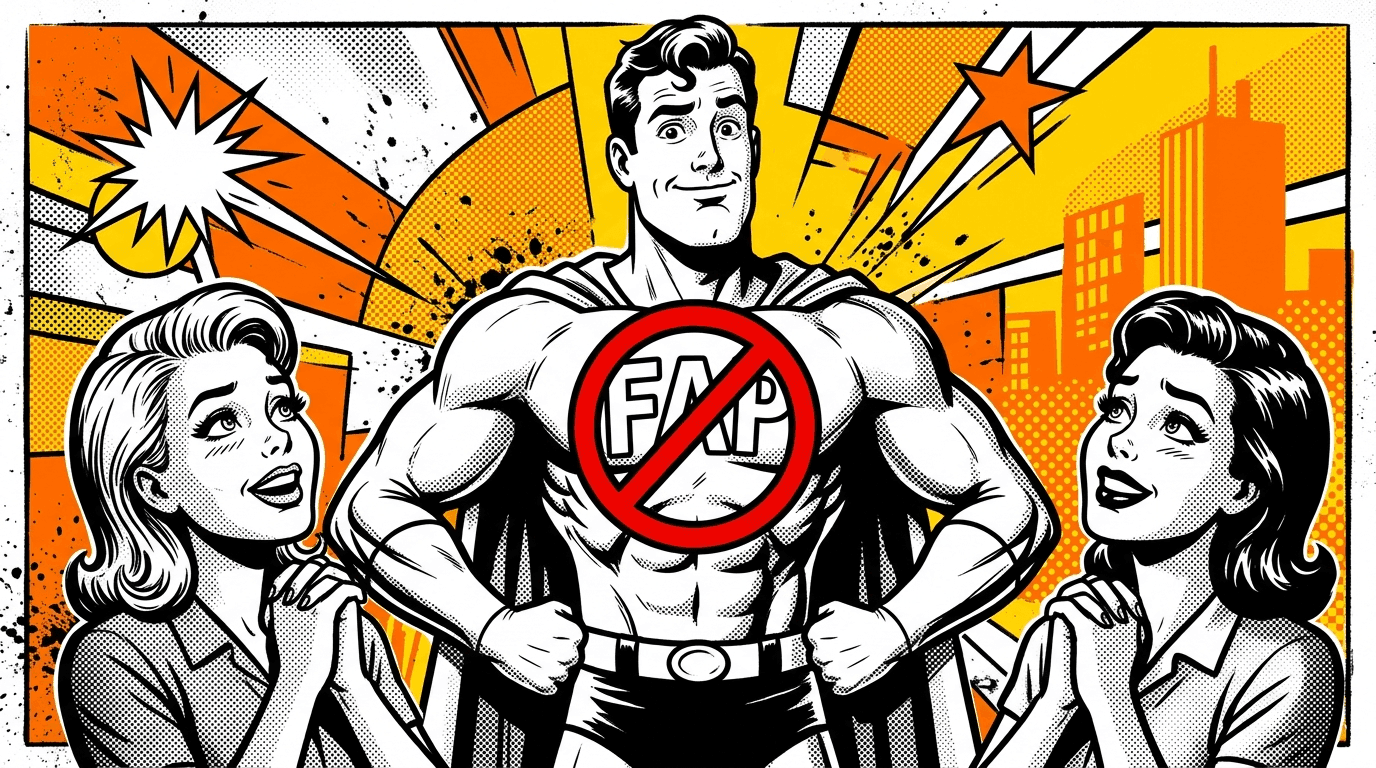
Most guys who are on a journey to quit porn come across NoFap at some point and there, you'll inevitably find reports of "superpowers".
It goes something like this: when you quit porn (and stop fapping), your testosterone shoots through the roof, your confidence explodes, you go from brain-fog to laser-sharp focus, every woman in a 10 mile radius is suddenly, irresistibly drawn to you..
Those sound like very compelling reasons to quit, right? Surely, this is a strong WHY?
But really, it's the opposite.
The superpowers narrative is probably the most common weak WHY there is. And it fails in a particularly frustrating way. There's a whole breakdown of why this approach sets most men up to fail, but the core problem is that believing in NoFap superpowers fails both of the criteria of a strong why:
First, you can't really believe it. The claims don't hold up to scrutiny. The testosterone claims are based on weak and widely debunked research. Hormones are complicated, and the idea that not masturbating for thirty days will significantly shift your hormonal profile is a real oversimplification. Any honest look at the evidence starts to loosen your grip on this as a reason.
Second, it disproves itself. You hit thirty days. You wait for the superpowers. They're not really showing up the way you were promised. Now your WHY is being actively undermined by your own lived experience. Which means now, you believe it even less and you also no longer feel it. Or more precisely: instead of feeling hope and excitement, you feel disappointment.
You want a reason that gets stronger the longer you hold it, not one that fades as the initial motivation wears off.
The Unfortunate Truth: Rock Bottom as a Strong Why
A reason I'm laying out this specific strategy for creating a strong WHY is because of what happens when you don't:
A strong WHY eventually shows up all by itself.
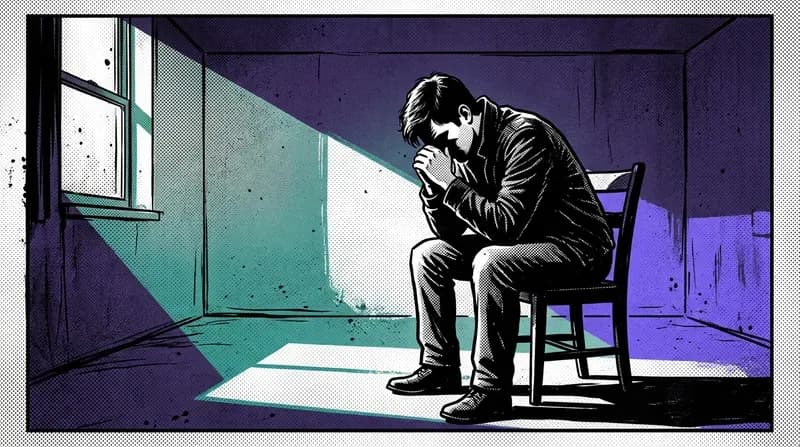
It's when you start having erectile dysfunction in your 20s and you realize: here was my chance to have real sex and I can't do it or enjoy it because I've ruined myself with porn.
Or worse, you become the man who loses his marriage, his home, his kids, all because his porn addiction escalated to a level where his wife had to draw a line in the sand and leave.
In a moment like that, you clearly undestand what happened. You sit in the wreckage of your life and see what porn use caused. I will never let this happen again. That's genuine. It's felt. It's believed.
It's also a terrible idea to wait until you hit rock bottom.
By the time addiction has escalated far enough to produce that kind of pain, it's deeply ingrained. It would have been far better to quit years earlier. And if you don't address it now, the next rock bottom is worse than the last. That's how escalation works. Each threshold you cross makes the next one easier to cross.
The whole point of building a strong WHY deliberately is to reach that level of commitment before the pain forces you to.
By the way, if you're currently in a relationship and want to avoid an outcome like this, I have a detailed guide for you here.
Where to Look for Your Strong WHY
So how exactly do you find your own strong WHY before you hit rock bottom?
There are four domains worth exploring. Not all of them will resonate, and that's fine. The goal is to find the one or two that genuinely land, then go deep on those. Do your own research, read the books, look at the studies.
1. Your Brain & Attention
What is this habit doing to your ability to focus? To feel genuinely interested in things? To be present in a conversation without your mind drifting? Chronic high-stimulation habits reshape the brain's reward system in ways that dull everyday experience and erode the ability to stay with anything that doesn't deliver instant gratification.
Dopamine Nation by Anna Lembke is a great book to read if you want to dive deeper into this topic. It's not specifically about porn. It's about addiction and the dopamine system broadly, which actually makes it more useful. You come away with a solid, evidence-based understanding of what's happening inside you, not just a list of reasons someone told you to care about.
Also, check out this post that explains how porn affects your dopamine system.
If your attention span and your capacity to be present actually matter to you, this domain is worth developing.
2. Sex & Relationships
The data here is worth knowing clearly. Research tracking pornography use over time has found that beginning regular porn use roughly doubled the probability of divorce among married Americans. The causation runs from porn use to relationship breakdown, not the other way around.
Even if you're single and can't fully relate to the relationship stakes yet, there's a version of this that applies right now. I use the "brain training" frame to make sense of this.
Think of porn as "training" your brain to associate arousal with a very specific set of circumstances: alone, passive, screen-based, frictionless. The more you train this association, the more you'll struggle with real intimacy.
3. Your Time & Your Life
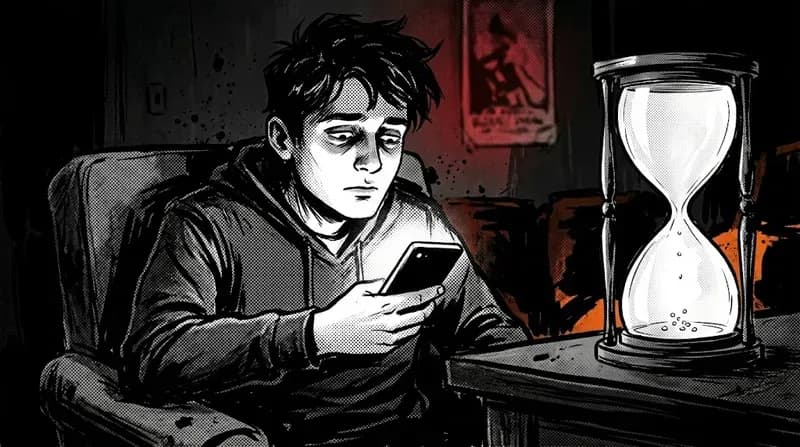
Porn addiction is expensive. And no, I'm not talking about your OnlyFans subscription (althrough that can be expensive too).
Even if you've never spent a dime on porn, it's expensive in ways that are far more costly: hours consumed. Creative energy redirected. Presence in your own life reduced to passive consumption. It's worth asking yourself: what is this costing me now, and also what could I build with the years I'm giving to this?
4. Virtue & Being a Good Man
Finally, consider your values as a man, as a human being. Perhaps you are religious, in which case your faith has things to say about how you ought to relate to sex and sexuality. The unfortunate truth is, if you have a strict religious background, you are at a disadvantage for quitting porn. But it's still something you have to account with.
And if you don't have a religious bone in your body, the question is still: how do you want to conduct yourself in this life? What kind of a role model do you want to be to others? How do you want to treat yourself, your mind, your body?

Make Your WHY a Daily Practice
The easiest way to go from a jumble of vague ideas to a STRONG WHY is to start writing.
You can start right now: right down whatever comes to mind as your reasons. Why do you want to quit porn?
Then ask yourself honestly: do I believe this? Does it actually land when I read it back?
Whatever comes out, that's your material. Then do the research. Go deeper on the domains that resonated. Come back and revise what you wrote. Do that until you land on something specific enough that when you read it back to yourself, it actually touches you. It means something.
It can be one sentence. It can be a paragraph, or many. Length doesn't matter, only that it's genuinely yours: your values, your life, your actual reasons. Not borrowed from a forum post or a video.
Once you have it, read it every day. Put it on your mirror or set it as a phone note. This isn't a motivational ritual. It's a neurological one. After two months of reading those same words every day, they start surfacing automatically when urges arise. The WHY becomes a reflex rather than something you have to consciously retrieve under pressure. That's when it becomes a real defense mechanism.
That's the shift. From a vague sense that you should probably get around to quitting, to a reason so clear and felt that it shows up on its own when you need it most.
If you want to discover how writing is the most powerful tool to build awareness and quit porn, check out the free Introspective Writing Crash Course here.
And if you want a systematic approach to quitting porn and healing your brain as efficiently as possible, you can learn more about the QuitByHealing Program here.
About the Author
Shane is a serial entrepreneur with a long-standing obsession for personal development and life optimization. He has a habit of buying more books than he can ever read. During his childhood his worldview was significantly influenced by Jackie Chan movies, the Vorkosigan Saga and the writings of Miyamoto Musashi.

Shane Melaugh
There is a Better Way to Quit.
Stop relying on sheer willpower. Learn the step-by-step psychological framework that makes quitting inevitable.