Monogamy, Desire, and the Lie That’s Fueling Porn Addiction
The fairy tale romance, a perfectly sexually fulfilled, forever-committed monogamous partnership, is what most men measure themselves against, and almost nobody achieves it. The shame of falling short is a primary driver of porn addiction.
 Shane MelaughPublished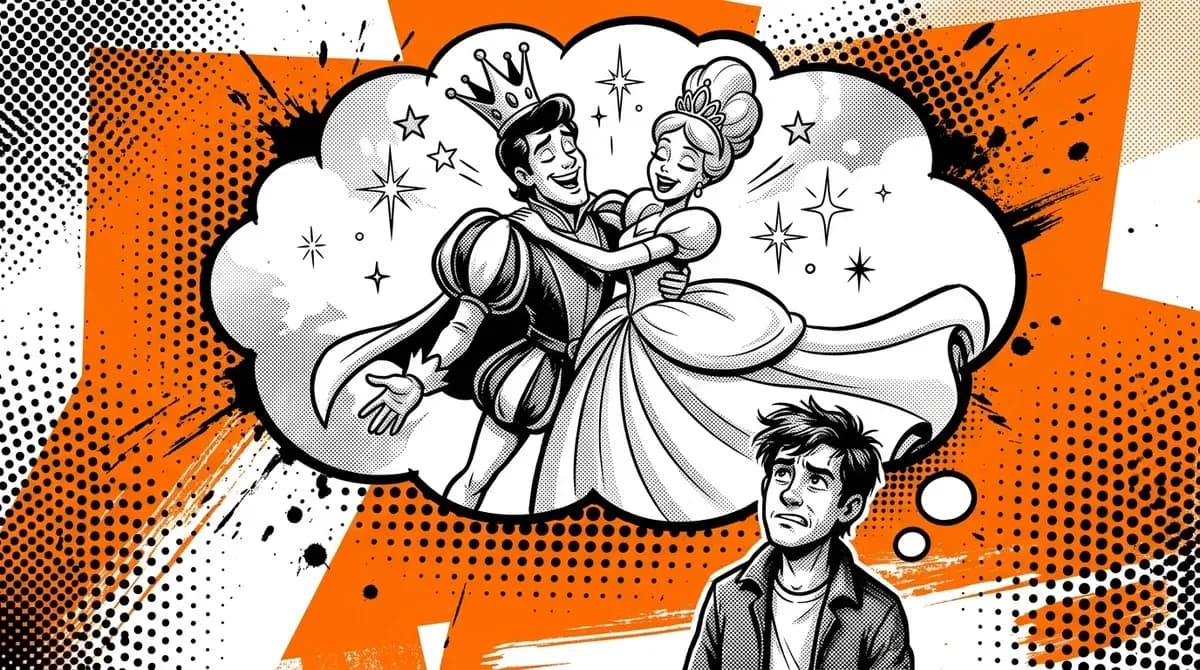
There are two kinds of shame that come with relationships.
The first is wanting someone you're not supposed to want. Feeling desire for someone who isn't your partner, or having desires that don't fit the script of what you're supposed to feel in a good, traditional, monogamous partnership.
The second is relationship "failure". A breakup, a marriage that fell apart. Years of trying to build something long term and watching it end anyway.
In either case, the thoughts keeps haunting you:
"There's something wrong with me."
"I couldn't do the normal thing that everyone else seems to manage".
I wish someone had told me twenty years ago that the stories that cause this shame are a lie.
TL;DR: The fairy tale romance (sexually exclusive, permanently fulfilling, effortlessly committed) is what most measure themselves against, but almost nobody achieves. The data shows it works out for maybe 10-15% of people who try for it. The shame of being in the other 85% is a primary driver of porn addiction and a lot of unnecessary suffering.

What Is the Fairy Tale Romance Script?
The "normal" relationship you were told about all your life is the "fairytale romance". From your parents, from your community, school, movies and other forms of media, this has been hammered into your subconcsious all your life.
The script goes something like this: you date around in your 20s until you find "the one". By your early 30s, it's time to get married and start a family and it's basically happily ever after from there.
Since you found "the one", your soulmate, you fulfill each other completely. Your relationship is harmonious. And you never have serious conflicts and you certainly don't have eyes for anyone else.
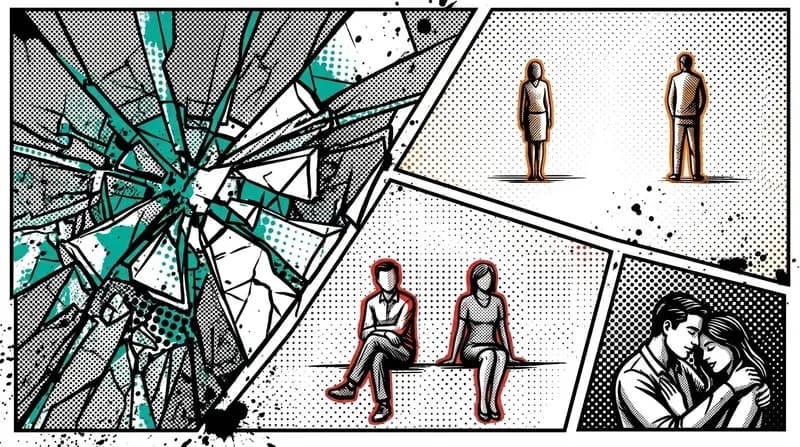
Any deviation from this gets tagged as a failure. Still single in your late 30s? You must be doing something wrong. Need couple's therapy? You must have f-ed up. Feeling desire outside your relationship? Something's broken in you. Relationship ended? You failed.
I measured every experience against this template and came up short repeatedly. The shame that generated was enormous. And it had consequences I didn't understand until much later.
What Does the Data Actually Show?
So this relationship story that you've been told is normal, let's see how it holds up to reality.
First off, the divorce rate has hovered between 40-50% for decades. About half of all marriages end in divorce. That's just the visible failure.
Next, let's talk about cheating. According to a General Social Survey, analyzed by the Institute for Family Studies, about 20% of married men and 13% of married women admit to infidelity.
The key word there is "admit". The people who did it and won't admit it, even anonymously, aren't counted. One study into long-term relationships estimated the real infidelity rate could be closer to 44%.
Then there's "roommate syndrome" - couples who are technically still together but have stopped being romantic or sexual partners. The relationship became a household arrangement. Research published in the Archives of Sexual Behavior estimates roughly 15-20% of married couples are in sexless marriages. The fairy tale ended. Nobody moved out.
Put it together, and you get the estimate from Dr. Ty Tashiro's The Science of Happily Ever After: about three out of ten married couples experience a genuinely happy, sustainable, long-term monogamous relationship.
Three out of ten. And that's only counting people committed enough to get married in the first place.
Monogamous Relationships that Aren't Monogamous
And we're still not done. Even some of the apparently functional monogamous relationships aren't actually monogamous.
Research in the Journal of Sex & Marital Therapy by Haupert et al. found about 21% of adults have consensually engaged in non-monogamy at some point.
A 2023 YouGov poll found 34% of American adults describe their ideal relationship as something other than complete monogamy.
Sex columnist Dan Savage coined the term "monogamish" for what many committed couples practice without telling anyone about it: functionally committed, with agreed-upon flexibility behind closed doors.
Foundational sociological research by Laumann et al. has long tracked how wide the actual range of human sexual practice is, well beyond what the public script acknowledges.
What they found is that there's a fairly common phenomenon of "Closeted Consensual Non-Monogamy": couples who don't fit the traditional relationship model, but they keep it a secret to avoid fallout from their community, church or family.
When you account for all of it (closeted non-monogamy, roommate syndrome, couples who look fine from the outside and aren't), the real rate of fairy tale monogamy is probably closer to 10-15% of people who genuinely attempt it.
The majority of people who aim for the fairy tale don't get it.
I'm not saying this to be cynical about relationships. I'm saying it because the story you've been told is normal is actually a statistical outlier, and measuring yourself against it is like failing to run a four-minute mile and concluding you're not an athlete.
This is the key idea: if you've struggled to acheive a happily-ever-after relationship or you have desires that don't fit perfectly into the "monogamy" box, you aren't wrong or strange. You're part of the 85% majority.

Why This Is Fueling Your Porn Habit
QuitByHealing is about overcoming porn addiction so why am I writing about relationship statistics?
Because for me, the shame about my inability to have the fairytale romance was one of the things that kept me hooked on porn.
When you're a man who has strong sexual desires, desires that don't fit neatly into the fairy tale script, you absorb a consistent message from the culture: you're the problem. You want too much. You're not capable of the devotion a good partner deserves. Your desires are wrong, maybe sinful, definitely not what a healthy person would feel.
So you suppress them. You feel shame about them. You try to be the version of yourself the script says you should be.
And then you find porn.
Porn, for a man carrying all that shame, is the one place where none of it applies. Every desire you have is welcomed. Nothing is wrong. Nothing is too much. What a relief!
Of course that's addictive.
I didn't understand this for a long time. I thought my relationship with porn was a willpower problem. I kept trying to fight it with discipline. But as long as I felt all this shame about my desires, no amount of willpower could keep me from relapsing.
I've written separately about how to address porn addiction inside a relationship and a big part of that is also about acknowleding and dissolving all this shame.
Here's a key takeaway:
You cannot shame yourself into better behavior. You cannot shame other people into better behavior either, by the way. It simply doesn't work. The only solution is to dissolve the shame itself.
Can Switching Relationship Structures Fix It?
You might read all this data and conclude: "monogamy doesn't work, I should try polyamory."
That would be jumping the gun a little bit.
A 2025 meta-analysis of 35 studies covering nearly 25,000 participants found no significant differences in relationship or sexual satisfaction between monogamous and non-monogamous couples.
Relationships are just difficult, regardless of how they're structured.
If you're in a difficult relationship right now, switching structures won't save it. If you're single and searching, getting into a more open arrangement won't suddenly make things easier. The challenge is consistent across relationship types.
So the answer isn't some external change. The answer is what happens internally.
Two Things That Actually Help
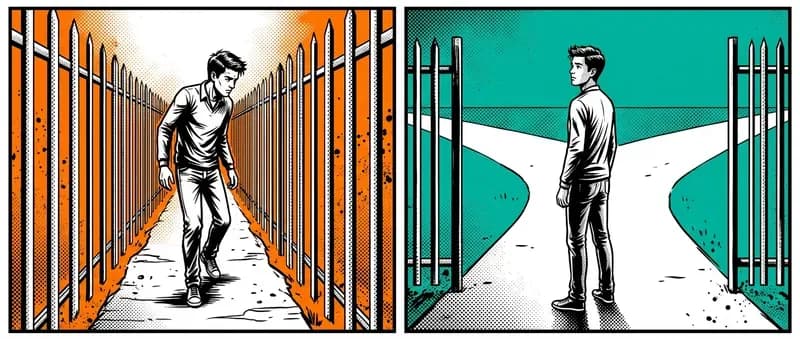
What can you do to dissolve your shame around this topic? The foundation is what I've presented here: seeing the reality behind the fairytale. When you can see how normal relationship struggles, relationship endings and non-monogamous desires really are, you can no longer tell yourself a story about how you're uniquely broken and wrong.
In addition to that, here are two practical things to do:
Stop Using the Fairy Tale as Your Benchmark
If you're in a relationship and you're going through a dry spell, feeling desire for someone else, doubting whether this is forever etc, stop seeing that as a sign of failure.
Stop making everything personal and spinning a story about how it's all your fault.
Every long term relationship comes with doubt, obstacles, periods of disconnection, the need to repair. Every truly sustainable relationship comes with the occasional uncomfortable conversation.
Great relatioships are about making it through these rough patches, not about avoiding them altogether.
You can still choose monogamy and you can still choose to aim for the happily ever after outcome.
But do it knowing the bumps along the way are normal, and you can bring them into the light instead of hiding them and accumulating shame.
Something I've seen in my work many times: the men who make real progress aren't the ones who suddenly get everything right. They're the ones who get better at giving themselves some grace when things go sideways.
Put More Options on the Table
This isn't a recommendation for any particular configuration. It's an invitation to think clearly about what you actually want, without the noise of shame distorting the signal.
You might find strict monogamy genuinely is what you want. You might find you want something more flexible. You might try something, find it doesn't work, and return to something else. All of it. The trying, the confusion, the failed attempts, the course-correcting. That's what actual healing looks like. It's normal human experience.
Give yourself grace for the struggles you have and the uncertainties you have. Whenever you catch yourself running the story (I'm wrong, I'm broken, I'm not doing this right), see if you can step back from it. Notice the shaming. And then ask: can I be curious about this instead?
The more you can meet yourself with that kind of curiosity and honesty, the less of this shame burden you carry around, and the less you'll find yourself needing to escape into the one place that used to feel like the only welcome you had.
If you want some concrete tools for developing this, particularly if you're working through porn addiction or other compulsive behaviors, check out my free Introspective Writing Crash Course. It's designed to help you use writing to build a more honest, kinder relationship with yourself. That's the starting point.
References
- Tashiro, T. (2014). The Science of Happily Ever After. Harlequin. https://books.google.com/books/about/The_Science_of_Happily_Ever_After.html?id=QUbHAgAAQBAJ
- Anderson, E., et al. (2025). Countering the Monogamy-Superiority Myth. Journal of Sex Research. https://www.tandfonline.com/doi/full/10.1080/00224499.2025.2462988
- Institute for Family Studies. (n.d.). Who Cheats More? The Demographics of Cheating in America. https://ifstudies.org/blog/who-cheats-more-the-demographics-of-cheating-in-america
- Archives of Sexual Behavior. Springer. https://link.springer.com/journal/10508
- Haupert, M.L., et al. (2016). Prevalence of Experiences With Consensual Nonmonogamous Relationships. Journal of Sex & Marital Therapy. https://www.tandfonline.com/doi/abs/10.1080/0092623X.2016.1178675
- Laumann, E.O., et al. (1994). The Social Organization of Sexuality. University of Chicago Press. https://books.google.com/books/about/The_Social_Organization_of_Sexuality.html?id=72AHO0rE2HoC
- YouGov. (2023). How Many Americans Prefer Non-Monogamy in Relationships? https://yougov.com/en-us/articles/45271-how-many-americans-prefer-nonmonogamy-relationship
About the Author
Shane is a serial entrepreneur with a long-standing obsession for personal development and life optimization. He has a habit of buying more books than he can ever read. During his childhood his worldview was significantly influenced by Jackie Chan movies, the Vorkosigan Saga and the writings of Miyamoto Musashi.
Shane Melaugh