
Most guys try to quit their porn addiction the hard way. Willpower, discipline, maybe some app blocking software that you inevitably find a way around after a few days…
It’s frustrating and can make you feel like nothing works.
After reaching millions of people with my content, running a community with over 5,000 members and working with many men directly, I can tell you one thing you must understand to break the cycle. It’s called the Habit Loop and in this post, you’ll learn exactly how it can set you free.
TL;DR: Your brain doesn’t care if a habit is good or bad: it just makes repeated actions automatic. Instead of fighting the urge to watch porn, identify and eliminate the triggers that create the urge in the first place. This approach is the key to targeting the root cause rather than the symptom.
Your Brain Doesn’t Judge Your Habits
Here’s something that took me way too long to understand: your brain is completely neutral about the habits you build. It doesn’t distinguish between locking your door when you leave the house and opening that incognito tab at midnight. Both are just repeated actions that your brain optimizes for efficiency.

Think about learning to drive. At first, every single action required conscious thought. Check mirrors. Signal. Look over shoulder. Merge. It all felt a bit overwhelming.
Now? You can drive across town while your mind is completely elsewhere, having full conversations or planning your weekend. Your brain took all those individual steps and bundled them into one smooth, automatic process.
The key insight is that this is how ALL habit forming works. Regardless of whether you think of them as “good” habits or “bad” habits (I got this from the book Good Habits, Bad Habits by Wendy Wood).
Your porn habit works the same way. You’ve practiced the sequence so many times that your brain has become incredibly efficient at it. You’ve become very good at watching porn. That’s not a moral judgment. That’s just neuroscience.
Understanding this concept is crucial for anyone serious about recovery, which is why I’ve explored the brain science behind digital hyper-stimulation in depth elsewhere.
The Problem With Most Recovery Approaches
Most guys focus on the wrong part of the habit cycle. They put all their energy into stopping the action, the actual watching of porn. But by the time you’re reaching for your phone or opening that browser, the habit loop is already in motion. The trigger has fired, the craving has started, and you’re already moving toward the polar opposite of where you want to be.
Every habit has three parts: the trigger, the action, and the reward. This is the Habit Loop.
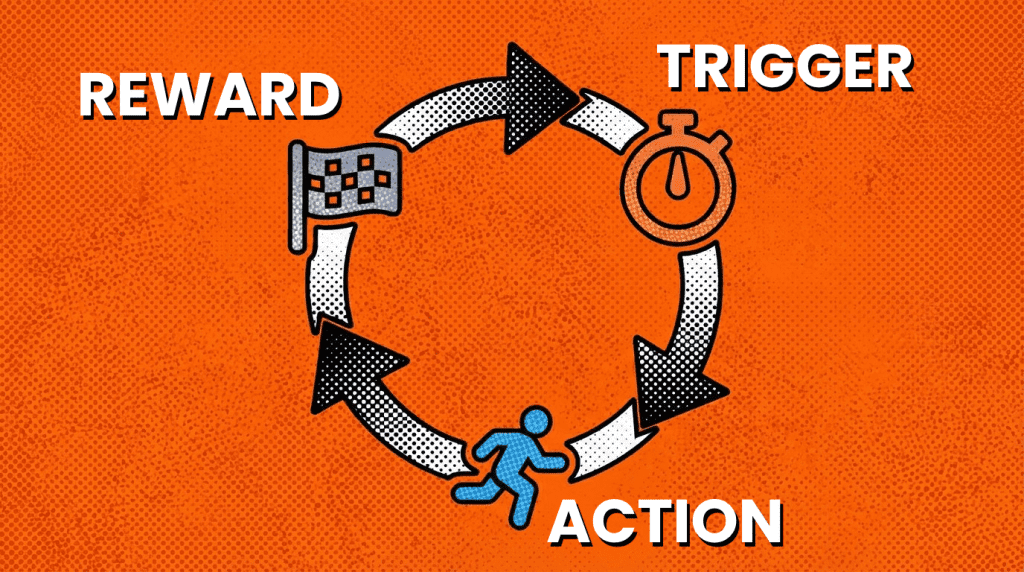
The trigger is what starts the whole process. Maybe it’s seeing something on Instagram. Maybe it’s that specific feeling of frustration after a long day. Maybe it’s just being in your bedroom at a certain time of night.
The action is obvious: watching porn.
The reward is the temporary relief, the dopamine hit, the escape from whatever you were feeling.
Here’s the thing most people miss: if you want to quit porn (or any bad habit), focus on the trigger not the action part of the loop.
Fighting the action is like trying to stop a boulder that’s already rolling down a hill. Instead, you want to ensure that the boulder never gets rolling in the first place.
This is where the practice of witnessing becomes essential. Instead of getting caught in the automatic reaction, you learn to observe the trigger without immediately acting.
Tiny Changes, Huge Effects
Let me tell you a stupid simple example of how you can intervene at the trigger instead of the action:
Imagine you have this porn use habit: every evening around 9 PM, you sit in this specific chair in your bedroom with your laptop and you tell yourself you’ll just quickly “check email.” We both know how that ends…
Now, what happens if you move the laptop to the kitchen table?
No dramatic change, no app blocking software, nothing crazy. You just make sure that your laptop is somewhere else.
The next evening around 9 PM, you’ll sit in your chair as usual, you’ll reach for the laptop… and it’s not there.
This is your opportunity! In that moment of confusion: where’s my laptop? You pause and actually notice what you’re doing. The autopilot is interrupted. You’re back to having a real choice.
You can still walk over the the kitchen, get your laptop and get back into your addiction loop. But you have a real chance to make a different choice and that’s a game changer.
This is exactly the kind of environmental design strategy that can make or break your recovery, and there are many more practical approaches I cover in my complete toolkit for stopping urges.
Find Your Invisible Triggers
If you’re going to remove your triggers, you first need to know what they are.
Most guys can identify the obvious triggers quickly enough: Instagram thirst traps, certain websites, that HBO show with too many sex scenes…
Those surface-level cues are easy to spot and eliminate. But the sneaky triggers run much deeper and often operate completely below conscious awareness. These are the ones that will sabotage your recovery if you don’t learn to recognize them.
For example:
- Feeling frustrated
- Feeling bored
- Feeling sad
- Other emotional states
- Restlessness
- That feeling of “I should be doing XZY but I really don’t want to”
Even specific times of day can be a trigger. For me, it was always between 8 and 10 PM. For others, it’s first thing in the morning or during lunch breaks.
Transition moments can also be strong triggers. For example right after work or before bed.
How to Interrupt the Habit Loop
Now that you know this, what can you do to actually beat your porn addiction (or break any other bad habit)?
Step 1: Map Your Triggers
The first step is simple: grab a pen and paper (or open a notes app) and write down every trigger you can think of.
Every time you feel the urge come up, write it down. Where are you? What are you feeling right now? What were you doing just before? What time is it?
The patterns became obvious fast. Frustrated after work calls. Bored on Sunday afternoons. Lying in bed scrolling your phone before sleep.
Step 2: Change What You Can Change
Environmental triggers are the easiest to fix. Clean up your social media feeds. Move your devices. Change your evening routine. Sit in a different chair.
I started charging my phone in the kitchen overnight instead of keeping it by my bed. Small change, massive impact.
For each trigger in your list, ask yourself: how can I change or eliminate this? Can I remove something from my environment? Can I join a class or go to a social event so I’m not at home during these times?
Step 3: Catch the Internal Triggers
Emotional triggers require a different approach. You can’t eliminate frustration from your life, but you can learn to notice it before it pulls you into old patterns.
When I felt that familiar restless energy starting to build, I’d pause and ask: What am I actually feeling right now? What am I trying to avoid?
Sometimes the answer was boredom. Sometimes it was anxiety about work. Sometimes it was just loneliness. Naming it took away some of its power.
Here, the most effective thing you can do is learning to “sit in the fire”. Allow yourself to feel the feelings, even if they are unpleasant. Learn that you don’t have to respond to feelings, even if it feels like it at first.
Step 4: Have a Replacement Ready
Nature abhors a vacuum. If you interrupt an old habit without replacing it with something else, you’ll just feel restless and eventually go back to the old pattern.
When I caught myself reaching for my phone out of boredom, I’d do push-ups instead. When I noticed that 9 PM restlessness, I’d call a friend or take a walk around the block.
The replacement doesn’t have to be profound. It just has to be something that moves your body or your attention in a different direction.
These days, I have loads of habits that occupy me and offer a healthier outlet. I like to go for walks while listening to audiobooks. I go to the gym almost every day. I go on bike rides. I join dance classes and martial arts classes. I have an active social life – so much so that it’s sometimes hard to keep up. And that’s a great problem to have!
What to Expect in the First Weeks
Here’s what I wish someone had told me: changing a deep habit feels impossible for about two weeks, then gets noticeably easier. By two or three months in, the new pattern starts to feel natural.
Sometimes, those first two weeks are brutal. Your brain is basically throwing a tantrum because you’re disrupting its efficient system. The urges feel stronger, not weaker. That’s normal. That’s actually a sign that you’re doing it right.
Most guys quit during this phase because they think it means the approach isn’t working. The opposite is true. The resistance is proof that you’re rewiring something important.
This is why understanding the three stages of porn recovery can be so helpful. Each phase has its own challenges and timeline.
The Problem With App Blockers
I tried every blocking app and browser extension available. Some worked for a while, but I always found ways around them. Delete the app. Use a different browser. Switch to my phone when the computer was blocked.
The problem with external blockers is that they intervene at the wrong stage of the habit loop. They try to stop the action after the trigger has already fired. By then, your brain is already seeking the reward. You’ll find a way around the obstacle.
You need to learn how to say no to yourself, not rely on software to catch you after you’ve already fallen into the habit.
Don’t get me wrong: blockers can be helpful. They can give you that moment of pause, where you have a chance to change your mind. But after working with countless addicts, I can tell you that the benefits rarely last.
Real freedom comes from internal control, not external constraints.
The Question that Changed Everything
The shift from fighting my urges to understanding them started with one simple question. Instead of asking “How do I stop watching porn?” I began asking “What triggers the urge to watch porn?” This reframe moved me from a place of resistance to a place of curiosity, which is where real healing can begin.
That shift in focus changed everything. Instead of fighting myself, I started studying myself. Instead of relying on willpower, I started designing my environment and my awareness.
The urges didn’t disappear overnight. But they lost their automatic power over me. When I could see them coming, I had a choice. When I had a choice, I could choose differently.
What triggers are you not seeing yet?
If you’re ready to take this deeper, I walk through the complete process of identifying and interrupting these patterns in my full program.