How to Become a Man You Respect (Without Chasing Perfection)
Shane Melaugh

I spent most of my life feeling like I was bad at everything.
Not in a dramatic, cry-for-help kind of way. It just felt like a fact of life: while other guys seemed to have some natural talent or calling, I got skipped. A generalist in a world that rewards specialists. Anti-talented, if that's even a word.
What changed wasn't finding my hidden superpower. It was learning to ask the right question at the right moments. And how I asked that question made all the difference.
TL;DR: Stop asking "what would the perfect man do?" and start asking "what would a real man I respect do?" Use three checkpoints to calibrate your daily behavior: the man you don't respect (the floor), the ideal man (the unrealistic ceiling), and the real man you respect (the actionable target). The guy who aims for respectable beats the guy who aims for perfect, by a huge margin.
What's the Question That Actually Changes Your Behavior?
The question is simple: What would a man I respect do in this situation?
This seems very simple, but don't underestimate it. This is a decision-making tool you use in real time. When you're facing a choice, when something difficult comes up, when you're asking yourself what should I do next, you run it through this filter.
The value is obvious. If you consistently make choices based on what a respectable man would do, your life starts trending in that direction. Your behavior calibrates itself toward better outcomes, better relationships, better health. It's one of the fastest ways to become someone you actually respect.
But here's where most guys get it wrong.
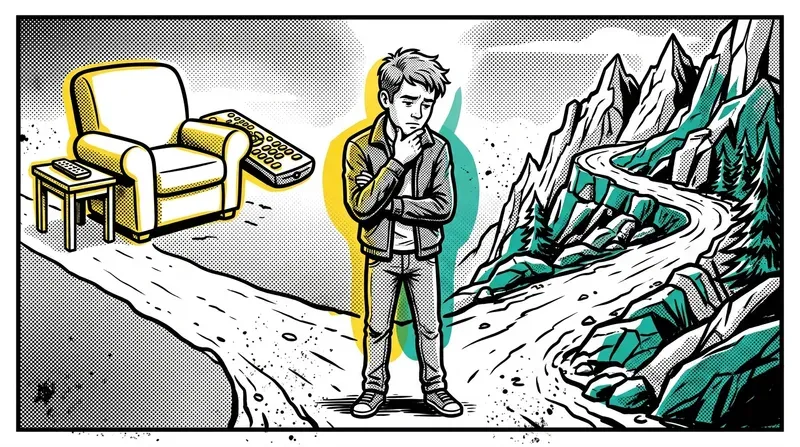
Why Aiming for the "Ideal Man" Makes You Worse
Try this experiment: Think about how you typically start your day.
Now ask yourself: how would a man you respect start his day?
If your answer sounds something like "wake up at 5 AM, cold shower, meditate for 30 minutes, hit the gym, hyper-focused work session," you're answering the wrong question.
You're not describing a man you respect. You're describing Gigachad. The ideal. The Terminator who never has a weak day, never lacks motivation, and never eats pizza at midnight.
That's not a human being. That's a fantasy.
And orienting your entire life toward a fantasy creates a very specific, very damaging pattern.
It goes like this: you aim for perfect. You fall short. You feel disappointed. You aim for perfect again. You fall short again. And again. And again. You lose motivation and start feeling like a failure...
Research on perfectionistic concerns consistently links this kind of rigid standard-setting to worse performance, increased burnout, and higher rates of anxiety and depression.
The irony is brutal. The guy chasing perfection in every area of his life doesn't end up performing better. He ends up performing worse. Because constant failure is exhausting. It drains the energy you need to actually show up and do the work.
This same pattern shows up in how the habit loop keeps people stuck in addictive cycles. The more you fight something with brute force willpower, the more you deplete the very resources you need to win.
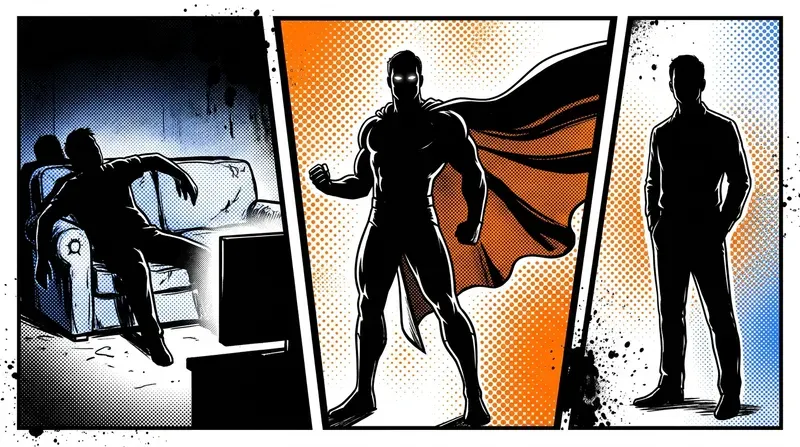
The Three-Checkpoint Framework
Here's the tool I use instead. For any situation where I'm deciding what to do, I check in with three different orientations. Not just one. Three.
Checkpoint 1: What Would a Man I Don't Respect Do?
This establishes the floor. The behavior you want to avoid. The excuses, the shortcuts, the path of least resistance that leads nowhere good.
You need to see this clearly so you can recognize when you're drifting toward it.
Checkpoint 2: What Would the Ideal Man Do?
This acknowledges the ceiling. Superman, Gigachad. The flawless version. It's useful to see this too, because it reveals the direction. But it's not your target.
Because you're not Superman. You're a real person with real limitations, bad days, and the occasional desire to stay in bed.
Checkpoint 3: What Would a Real Man I Respect Do?
This is the one that matters. A real man. Someone who has flaws, who has off days, who sometimes doesn't feel like doing the thing. But who consistently makes the best choice available to him in the moment.
Not perfect. Respectable.
This is where your actual actionable answer lives. And when you find it, you'll notice something interesting. It's almost always a more practical, more sustainable, and more effective choice than whatever the ideal version would look like.
Think of the men you know, whom you look up to. Maybe your dad, maybe an uncle, a teacher, a former boss... the best way to do this exercise is to think of a real person you've actually met. Not the projection of perfection that people on social media create.
A real man-you-respect role model helps you realize that you don't need to be superhuman or perfect to be a good man.
Three Scenarios That Show How This Actually Works
Let's make this framework a bit more practical. Here are three situations most guys will recognize.
Scenario 1: The Morning Gym Dilemma
You wake up exhausted. Your routine says go to the gym. Your body says stay in bed.
The man I don't respect just makes excuses. I'll go tomorrow. I deserve a rest day. He hits snooze, pulls the covers up, and the gym session never happens. Any reason not to go is good enough.
The perfect man rises out of bed like the Terminator. He never has weak days. He always trains at 100% intensity. He never gets injured. He doesn't even understand the concept of not wanting to go.
The real man I respect checks in with himself honestly. Am I just being lazy? If yes, he gets up and goes. Simple.
But if the answer is no, if he genuinely didn't get enough sleep or feels unusually rough, he adjusts. He gets an extra 45 minutes of sleep. He moves the workout to his lunch break. He commits to that plan and actually follows through.
The man I respect is flexible in his behavior without bullshitting himself. He can make a reasonable decision ("I need to get more rest today") while still sticking to his commitments (workout not skipped that day).

Scenario 2: Single and Unhappy About It
You're single. It's frustrating. What do you do about it?
The man I don't respect lives on dating apps. He swipes endlessly, gets ghosted constantly, and starts watching videos about how dating is broken. He scrolls Instagram looking at women he'll never talk to in real life. He gets bitter. Maybe he starts using porn to fill the void. He does everything except be proactive in the real world.
I've written about how porn becomes a displacement behavior when real-world connection feels too hard. The dating app loop feeds the same pattern: stimulation without real contact.
The perfect man is the perfect charmer. He walks up to anyone, anywhere, with effortless charisma. He's an unstoppable seduction machine and women flock to him wherever he goes.
The real man I respect acknowledges that dating apps are mostly misery generators and gets off them. He's honest with himself that he feels shy about approaching people in real life. So he does something about it. He challenges himself to talk to one stranger today. Two tomorrow. Three the day after. He works his way up to ten.
He recognizes that social skills are, well... skills. So he takes it upon himself to practice and improve and eventually, he has a satisfying dating life.
Scenario 3: A Conflict With Your Partner
You're in a relationship. Your partner says something that triggers you. You feel the anger or shutdown response rising.
The man I don't respect is completely hijacked by his emotions. He says things he regrets, then apologizes, then does it again next time. Or he shuts down entirely and pretends nothing happened. Either way, it's an immature response and nothing improves.
The perfect man always has the perfect response. He's never emotionally triggered. He always knows exactly what to say. He's some kind of emotional Jedi who never feels overwhelmed in a relationship situation, no matter what happens.
The real man I respect notices that he's getting triggered. He feels the anger or the shutdown coming. And instead of either exploding or pretending he's fine, he says: "I know we need to talk about this, but I want to make sure I don't say something I regret. I'm going to take a 15-minute walk to clear my head, and then we can talk."
Maybe she's a little upset that he's walking away mid-argument. That's not a perfect outcome. But he's making the best choice available to him in that moment. He's protecting the relationship from his worst impulses. That is respectable.
Noticing your emotional triggers before they hijack your behavior is the same skill that powers the entire healing process. It starts with awareness, not control.
Why the "Respectable" Guy Outperforms the "Perfect" Guy
Okay, at this point you understand this approach. But maybe you still feel like it's some kind of compromise. Like you "should" be Mr. Perfect but I guess sometimes you settle for less.
But here's the surprising thing: the guy who orients toward respectable, imperfect behavior doesn't just do "okay." He outperforms the perfectionist.
And it's not close. Mr. Respectable outperforms Mr. Perfect by a huge margin.
How is that possible?
Well, quite simply because nobody can ever be perfect. And because of that, the attempt to be perfect backfires.
The perfectionist is constantly falling short of his own standard. That constant disappointment drains motivation, drains energy, drains his willingness to keep showing up. Eventually he burns out or gives up entirely.
The guy aiming for respectable is consistently hitting his target. He builds momentum. He feels good about his choices, which fuels more good choices. He creates a positive feedback loop instead of a spiral of shame.
The world right now is flooded with images of the ideal. The fitness influencer with the perfect physique. People portraying flawless lifestyles on social media. Podcast conversations with the absolute pinnacle performers in every field. We've never been more exposed to perfection, and it's not making us better. It's making us paralyzed. Research on upward social comparison shows that constant exposure to idealized content on social media consistently lowers self-esteem and life satisfaction.
This is the same mechanism behind how hyper-stimulation warps your brain's sense of what's normal. Whether it's porn, social media, or productivity influencers, overexposure to the supernormal version of anything makes the real version feel inadequate.
Asking what would a man I respect do? cuts through all of that. It brings you back to reality. To what's actually achievable. And paradoxically, what's achievable produces far better results.
The One Exception: Pick Your Area of Mastery
You might be thinking: isn't it good to aim for perfection sometimes? Don't the best performers aim for total mastery?
Yes. In one area.
Realistically, you can aim for perfection and mastery in one area of your life. An area where you have a genuine affinity. Where you maybe have real talent, or a burning passion, or both.
For me, it's teaching. More specifically, my ability to learn something deeply, synthesize that knowledge, and pass it on in a way that actually helps people. That's the one area where I'm constantly pushing for better. Where I'll spend hours restructuring a single idea until it lands exactly right. Teaching in such a way that it helps people actually change is the one thing I am aiming to be the best in the world at.
Everything else? I'm a generalist. And I'm genuinely happy about that.
I used to feel like it was a bad thing to be a generalist. Like I wasn't good enough.
But here's what I've learned: being pretty good at many things while aiming for mastery in one is a dramatically more effective strategy than trying to be great at everything and falling short across the board.
If your one area is fitness, go all in. Perfect routine, perfect nutrition, perfect discipline. But accept that your relationships, your work, your creative skills won't also be at that same level. That's not failure, it's just a fact of life.
I've talked about this in the context of setting identity-based goals. When you define yourself by values instead of outcomes, it becomes a lot easier to aim for mastery in one area and accept good-enough everywhere else.
How to Start Using This Today
Pick one situation you'll face today. Could be anything. How you start your morning. How you respond to a frustrating email. Whether you go to the gym or not. How you spend your evening.
Run it through the three checkpoints.
What would a man I don't respect do? See it clearly. That's your floor.
What would the perfect man do? Acknowledge it. That's the direction. But it's not your target.
What would a real man I respect do? Find it. That's your move.
The more you practice this, the faster it becomes. Eventually you won't need to consciously walk through all three checkpoints. You'll just naturally gravitate toward the respectable choice.
What would the man you respect do right now?
About the Author
Shane is a serial entrepreneur with a long-standing obsession for personal development and life optimization. He has a habit of buying more books than he can ever read. During his childhood his worldview was significantly influenced by Jackie Chan movies, the Vorkosigan Saga and the writings of Miyamoto Musashi.

Shane Melaugh
There is a Better Way to Quit.
Stop relying on sheer willpower. Learn the step-by-step psychological framework that makes quitting inevitable.